
Safety First
Freediving always requires a trained buddy. Never practice breath-hold diving alone: shallow water blackout can occur without warning and is survivable only if someone is present to respond.
What Freediving Is
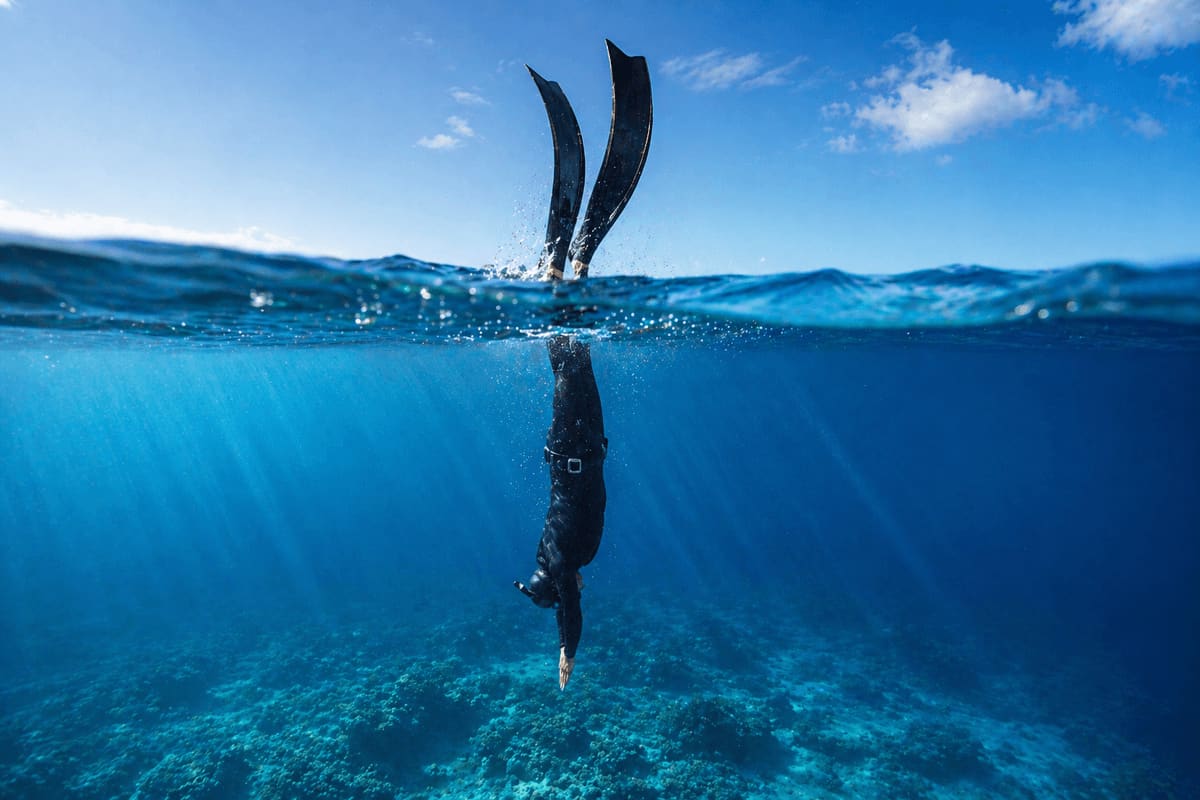
Freediving is diving underwater on a single breath. No tanks. No regulators. No hoses. You fill your lungs at the surface, go down, and come back up on the air you took with you. That single sentence is the whole definition of the sport, and everything else is detail.
You will see it written as freediving, free diving, and free dive. All three mean the same thing. In medical and scientific writing the same activity is usually called breath-hold diving or apnea, from the Greek word for without breath. The certifying agencies (AIDA, CMAS, SSI, PADI and Molchanovs) mostly use the single word spelling, which is why competitive results and course names read as freediving.
The sport spans an enormous range. At one end it is a person in a mask kicking down five metres to look at a reef fish for twenty seconds. At the other it is an athlete sinking past 100m in near darkness with a heart rate in the low thirties. Both are freediving. What they share is the constraint: one breath, and a body that has to manage it.
- Also called
- free diving, breath-hold diving, apnea diving, skin diving
- Core constraint
- a single breath, no external air supply
- Typical dive
- 5-20m depth, 30-90 seconds underwater
- Governing bodies
- AIDA International, CMAS, and training agencies including SSI, PADI, Molchanovs
Because the definition is so simple, people often assume the sport must be simple too. It is not. The skills that decide how deep and how long you go are equalization, relaxation, and efficient movement, and none of them are obvious from the outside. That is why almost everyone who progresses does so through structured beginner training rather than by trial and error.
Freediving vs Scuba Diving and Snorkeling
The fastest way to understand freediving is to put it beside the two activities it gets confused with. Scuba diving carries its air supply down with it. Snorkeling stays at the surface and breathes through a tube. Freediving does neither: it goes down, and it goes down on what is already in your lungs.
The differences that matter most are not on that table, though. A scuba diver is a visitor with a life support system strapped on. A freediver is closer to a swimmer who happens to be going down instead of across. Marine animals notice: dolphins, whales, turtles and reef fish behave differently around a silent, bubble-free diver, and most people who do both sports say the freediving version feels less like observing the ocean and more like being in it. The trade is obvious, you get one to three minutes instead of an hour. We break both comparisons down properly in freediving vs scuba diving and freediving vs snorkeling.
A Short History of Freediving
Freediving is not a modern invention. It is one of the oldest ways humans have used the sea, and for most of its history it was work rather than sport.
Sponge divers in the Aegean were descending on a breath with a weighted stone thousands of years ago. Pearl divers in the Persian Gulf and around Sri Lanka did the same for centuries. In Japan the Ama and in Korea the Haenyeo built entire local economies on women free diving for shellfish and seaweed, a tradition that still has practitioners alive today, many of them working into their seventies and eighties. None of these divers had wetsuits, fins, or a physiology textbook. They had technique passed down and a body that adapted.
The competitive era started in the mid twentieth century. In 1949 the Italian air force officer Raimondo Bucher dived to 30m on a bet, at a time when physiologists were confident the human chest would be crushed somewhere around that depth. He was fine, and the assumption collapsed with the record. Through the sixties and seventies Enzo Maiorca and Jacques Mayol traded depth records and pushed past 100m using weighted sleds, a rivalry that later became the loose basis for the 1988 film The Big Blue, which is still the reason many people first hear the word freediving.
AIDA International was founded in 1992 to standardise rules, judging, and record ratification, and CMAS added its own competitive structure. The sport professionalised quickly after that. Natalia Molchanova became the dominant figure of the 2000s and early 2010s, the first woman past 100m in constant weight and the holder of more than forty world records before her death in 2015. Her son Alexey Molchanov has since taken constant weight past 130m and founded the Molchanovs education system, now one of the main teaching bodies alongside AIDA, SSI, and PADI.
How It Physically Works
The reason a person can do this at all is that the human body carries a set of reflexes built for breath-hold diving. They are collectively called the mammalian dive reflex, they are involuntary, and versions of them exist in every air-breathing mammal that swims.
When you hold your breath and put your face in water, particularly cool water, your body starts reorganising itself within seconds:
- Heart rate slows (bradycardia)
- commonly by 10-25 percent and far more in trained divers, cutting oxygen consumption
- Peripheral vasoconstriction
- blood vessels in the arms and legs narrow, reserving oxygenated blood for the heart and brain
- Blood shift
- at depth, plasma and blood fill the chest cavity so the compressing lungs do not collapse
- Spleen contraction
- the spleen squeezes out stored oxygen-rich red blood cells, adding a few percent to circulating haemoglobin
There is a fifth factor that catches beginners out: the urge to breathe is not an oxygen alarm. It is triggered by rising carbon dioxide. That is why an untrained person feels desperate long before they are actually short of oxygen, and it is also why hyperventilating is dangerous. Blowing off CO2 delays the warning without adding any meaningful oxygen, so a diver can pass out with the alarm never having sounded. The reflex itself is worth understanding in detail, and we cover it in the mammalian dive reflex.
All of this strengthens with training. Regular divers show a faster onset of bradycardia, a stronger spleen response, and better CO2 tolerance within weeks. Very little of the improvement in a beginner's first year comes from lung size. Almost all of it comes from relaxation, efficiency, and the reflex sharpening up.
The Disciplines: Types of Freediving
Freediving is not one activity. Competitively it splits into pool disciplines, measured in time or distance, and depth disciplines, measured in metres. Each one isolates a different part of breath-hold performance, and each has its own world records and its own training approach.
A few notes on that table. Constant weight means the diver must return to the surface with the same weight they left with, which is what makes it the honest measure of depth performance and the discipline most competitions are built around. Free immersion is the gentlest of the depth disciplines and the one most instructors use to teach equalization, because you control your descent speed exactly with your hands on the rope. Variable weight and no limits are sled-assisted, no longer part of AIDA competition, and responsible for a disproportionate share of the sport's serious accidents. Full breakdowns of each are in the freediving disciplines guide.
Records move, so treat the elite column as a snapshot rather than a fixed figure. Women's records typically sit 10-20 percent below men's in depth and distance, with static apnea the closest of the categories. What matters more for a beginner is the shape of the gap: an elite constant weight dive is roughly five times the depth a well-trained recreational diver works at, which tells you how much of the sport is specialisation rather than baseline human capability.
Outside competition, most people never touch the majority of these. Recreational freediving is basically constant weight, done casually. When someone says they went freediving on the weekend, that is almost always what they mean.
What Recreational Freediving Actually Looks Like
The competitive numbers get the headlines, but they describe almost nobody. A normal freediving session looks like this: two or three people on a boat or swimming out from a beach, a float and a weighted line dropped to a set depth, and a rotation where one person dives while another watches from the surface. Dives last 40 to 90 seconds. Between dives you rest at the surface for two to three times the length of the dive. A two hour session might contain twenty or thirty dives, and most of it is spent breathing calmly and talking.
The other common formats are pool training, which is where technique and CO2 tolerance get built without weather or depth in the equation, and simple fun diving over a reef or wreck with a camera or a speargun. Many people train in a pool through winter and dive open water in summer.
Those bands vary a lot between individuals, and the single biggest variable is not fitness or lung size, it is how easily your ears equalize. Some people reach 20m in their first month. Others spend a season fixing equalization before depth moves at all, and that is normal. If you want to test the water without committing, a freediving taster session is a half-day introduction that most centres run for around $60-120.
Cost is lower than people expect. Beyond a course and a set of personal gear, freediving needs no air fills, no tank rental, and no service intervals, which is why the running cost is close to zero once you are equipped. Our breakdown of what freediving costs covers the full first-year figure.
Spearfishing
Many freedivers come to the sport through spearfishing, and the skills transfer directly. Breath hold, descent technique, equalization, and open water comfort are identical foundations. The differences are tactical: a spearfisher spends more time hunting shallow, holds still on the bottom rather than turning immediately, and dives in conditions and terrain a depth-focused freediver would avoid. The gear shifts with it, toward tougher and darker blades, which our guide to spearfishing fins covers.
That shallow, static style is also why spearfishing accounts for a large share of breath-hold fatalities. Divers stay down longer than planned because a fish is close, they often dive alone, and blackouts near the surface go unwitnessed. Spearfishing has its own rules around local regulations, protected species, and marine reserves, but the safety rules are the ordinary freediving ones and they apply just as hard.
Gear Basics at a Glance
Freediving gear is short list and it is mostly about efficiency rather than protection. You are trying to move through water with as little effort and as little drag as possible.
- Low-volume mask
- less internal air means less air spent equalizing the mask on the way down
- Long-blade fins
- bifins for general diving, a monofin for pool and deep training; stiff snorkeling fins do not work
- Simple J-tube snorkel
- no purge valves or dry tops, and it comes out of your mouth before you descend
- Wetsuit
- 3mm for warm water, 5mm for temperate, 7mm for cold; freediving cuts are smooth-skin and stretchy
- Weight belt
- rubber, worn on the hips, weighted so you are neutral at about 10m and positive at the surface
- Float and line
- a surface marker for boats, something to rest on, and a reference line to dive along
- Lanyard
- attaches you to the line so you cannot be separated from it in poor visibility
A workable beginner kit runs $300-500. Things to skip early: carbon fibre fins, open-cell suits, and expensive computers. None of them fix technique, and all of them are easier to justify once you know how you actually dive.
Safety Fundamentals
Freediving has one dominant hazard and a handful of secondary ones. Understanding the dominant one is not optional, because it is quiet, it gives no warning, and it is survivable almost every time if someone competent is watching.
Shallow water blackout
As you ascend, the pressure in your lungs drops and the partial pressure of oxygen falls with it. That is why loss of consciousness usually happens in the last 10m or at the surface, often on a dive that felt fine. There is no gasp and no struggle. A blacked-out diver held at the surface with their airway clear will typically resume breathing within seconds. A blacked-out diver alone will drown. This single mechanism is behind most freediving deaths, and it is covered in full in shallow water blackout.
The rules that prevent it
- 01 —Never dive alone. One diver dives, one watches from the surface, every single time.
- 02 —The safety diver watches continuously and meets the diver at the last 10m of the ascent.
- 03 —Never hyperventilate. Two to three minutes of calm normal breathing is the entire warm up.
- 04 —Surface interval of at least twice your dive time, and longer if you feel any doubt.
- 05 —Surface protocol every dive: recovery breaths, remove mask, give the OK sign, and hold the float.
- 06 —Add depth in 2-3m increments only when the current depth is comfortable and equalization is automatic.
The secondary risks are ear and sinus barotrauma from forcing equalization, lung squeeze from diving deeper than your flexibility allows or from a tense descent, and loss of motor control, known as a samba, which is a partial blackout and a clear signal to stop for the day. All of these are taught and practised in an entry level course, which is the main argument for taking one. The differences between the agencies are set out in the freediving certification comparison.
Is Freediving Right for You?
Freediving suits people who are:
- Comfortable in open water, not just in pools
- Fit enough for sustained relaxed swimming, roughly 200m continuous
- Patient enough to develop the mental side of breath holding
- Willing to always dive with a partner, without exception
There are genuine exclusions. Uncontrolled asthma, significant cardiovascular disease, a history of seizures, and ear or sinus conditions that block equalization all need a doctor's opinion first, ideally one familiar with diving medicine. Age itself is not a barrier at recreational depths. Neither is lung capacity, which correlates far less strongly with performance than beginners assume.
"The divers who improve fastest are almost never the fittest ones in the group. They are the ones who can lie in cold water doing nothing and be completely comfortable."
How to Get Started
The path into the sport is short and well worn. Following it in order is what separates people who reach 20m in a season from people who spend a year stuck at 8m with sore ears.
- 01 —Try a taster session or a pool apnea night at a local club, to find out whether you like the feeling before spending money.
- 02 —Take an entry level course: AIDA 2, SSI Freediver, PADI Freediver, or Molchanovs Wave 1. Expect 2 days and $150-350.
- 03 —Buy your own mask, snorkel, and fins first. Rent or borrow the wetsuit until you know your water.
- 04 —Find a regular training buddy from the course, someone who knows the rescue protocol.
- 05 —Train in a pool weekly. Static and dynamic work build CO2 tolerance and technique with zero depth risk.
- 06 —Work on equalization deliberately, on land and in shallow water. It gates depth more than anything else.
- 07 —Add depth in small increments in open water, always on a line, always with a buddy watching.
- 08 —Reassess after 6 months and pick a direction: depth, pool performance, spearfishing, or photography.
That is the whole sport. One breath, a body better built for it than you expect, a partner watching, and a patient approach to going a little deeper. Start with the practical beginner guide for the sequence of skills in detail.