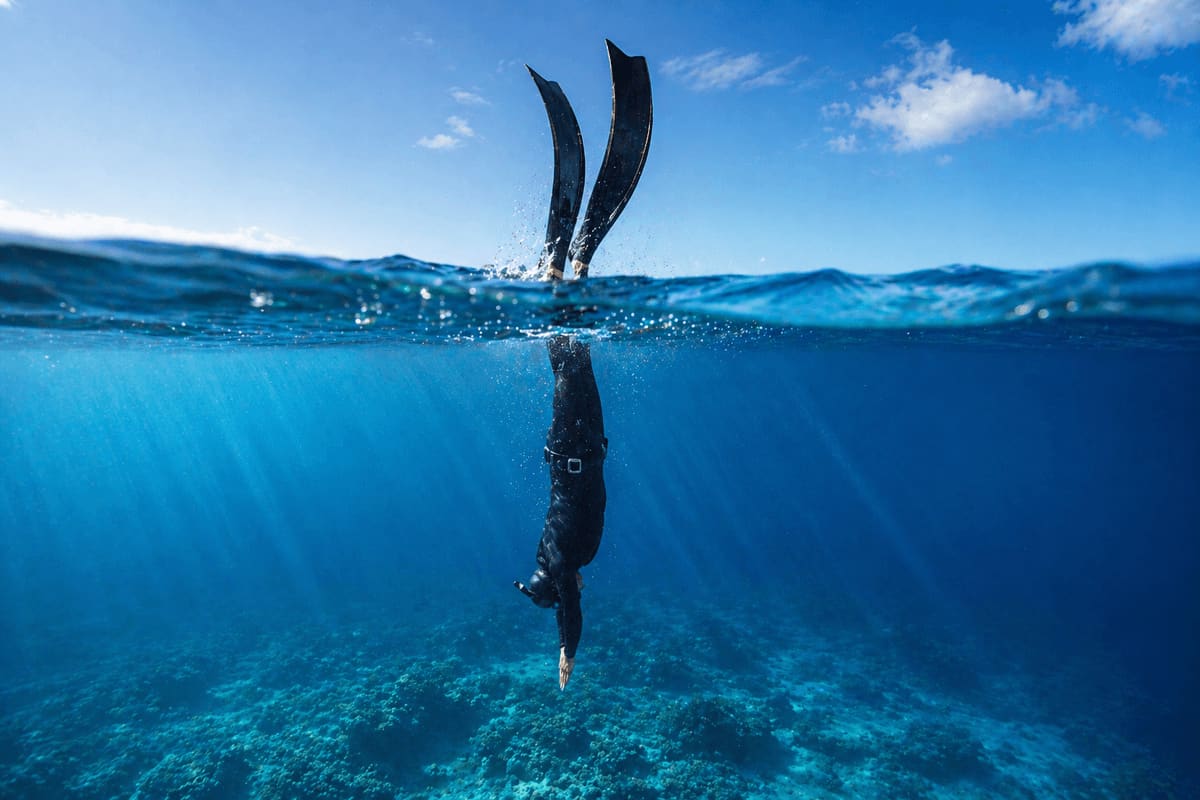

What Correct Weighting Looks Like
Weighting in freediving is not about sinking as fast as possible. It's about reaching a specific buoyancy balance (positive at the surface, negative from around 10-15m) so the water does the work of getting you to depth, and your natural buoyancy brings you back up.
- Float horizontally at the surface with a full breath
- Descend slowly with a relaxed exhale, no kicking required
- Reach neutral buoyancy at approximately 10-15m
- Below that: be carried down by negative buoyancy without active finning
That transition point, where you stop kicking and fall, is called free fall. Getting there cleanly is one of the more satisfying experiences in freediving.
The Variables
- Wetsuit thickness
- the dominant variable: neoprene is buoyant, the thicker the suit, the more weight you need to offset it
- Salt vs fresh water
- salt water is denser and provides more buoyancy: you need less weight in a pool than in the ocean, expect to add 1-2 kg when moving from pool to ocean
- Body composition
- higher body fat increases natural buoyancy, more muscular body types may need slightly less weight for the same wetsuit
- Lung volume
- your lungs at full inhale are the largest air space in your body, larger lung volume means more surface buoyancy
Starting Weights by Setup
These are starting points for salt water. Adjust after the pool test below.
Fresh water: subtract 1-2 kg from the above.
The Pool Test
Tables are starting points. The pool test gives you your actual number.
- 01 —Enter the pool with your wetsuit and starting weight: take a full breath and float on the surface, you should float comfortably without treading water
- 02 —Exhale fully and stop moving. You should begin to sink slowly. If you still float after a full exhale, add 0.5-1 kg and repeat
- 03 —Once you sink on exhale, test whether your neutral buoyancy point is around 10-15m. Descend to 10m without finning and observe: do you continue to sink (too much weight), float up (too little), or hover (correct)?
- 04 —Adjust in 0.5 kg increments until hovering at 10-12m without finning
This takes 20-30 minutes in a pool, and saves frustration and wasted dives in the ocean.
Where to Position the Weight
Lead weight sits on a rubber weight belt over your hips: front and sides, not directly over your kidneys or spine.
- Not restrict breathing
- Not press on hip bones when finning
- Not shift to your back when inverted
Some divers split between a hip belt and a neck weight to improve body trim on descent. A neck weight moves the center of mass upward, improving downward head orientation during free fall.
Common Mistakes
- Over-weighting to descend faster
- uses more oxygen on ascent and increases risk in any surface incident, under-weighting is always the safer error
- Not testing in the same gear you'll dive in
- a 5mm suit in the pool tells you nothing about a 7mm suit in cold ocean water
- Forgetting to adjust for salt vs fresh
- a correctly weighted pool setup will have you floating at the surface in the ocean, add 1-2 kg
- Testing at session start when cold
- cold water changes buoyancy, your warm-water neutral point is your real setup
The formula: start with the table estimates → run the pool test → adjust in 0.5 kg increments → confirm in the actual water you plan to dive. The number will be different for every wetsuit and water combination.