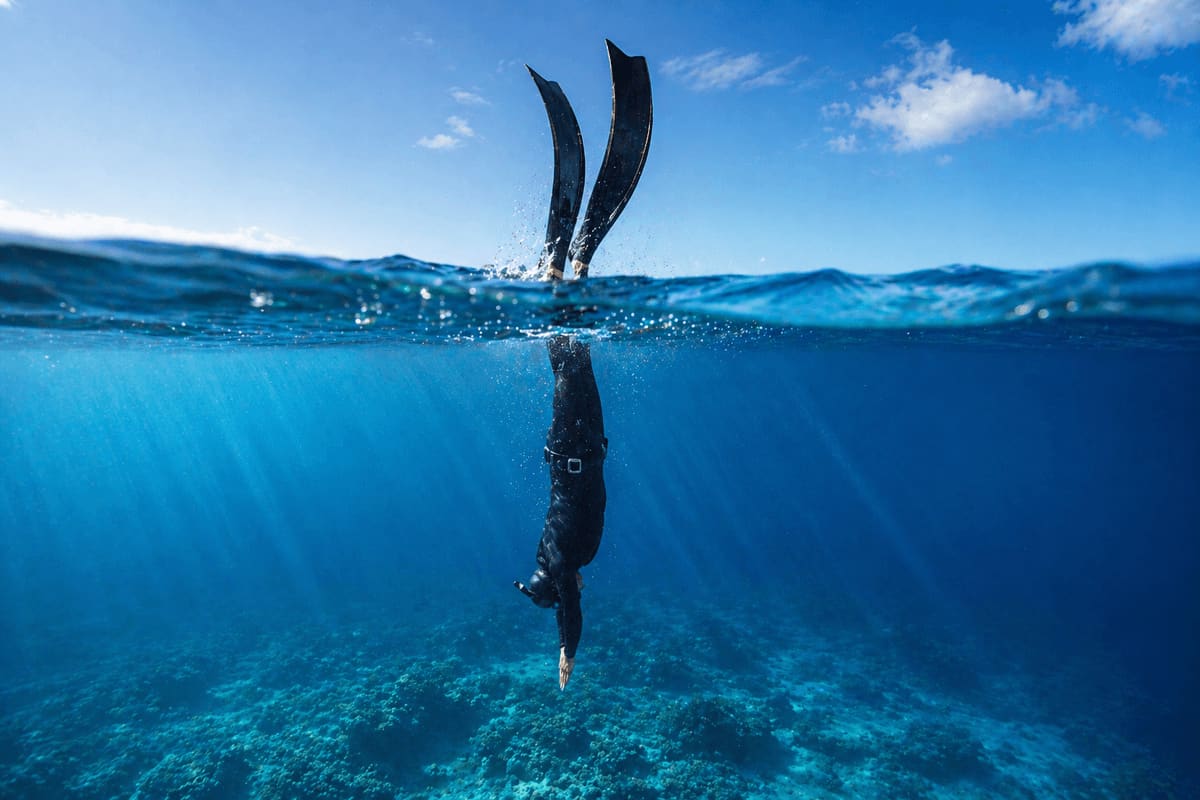

Depths by Experience Level
These are typical ranges based on training progression, not physical limits. Individual progression varies significantly based on breath-hold physiology, equalization skill, and water conditions. The numbers above represent safe training depths within each certification level.
AIDA Certification Depth Requirements
AIDA (Association Internationale pour le Développement de l'Apnée) is the main competitive freediving governing body and the most widely recognized certification for recreational training.
- AIDA 1
- Pool skills only, no open water depth requirement. Beginner introduction covering breathe-up, equalization basics, and pool safety. Duration: 1-2 days. Does not certify you to dive to any particular depth.
- AIDA 2
- The first open water certification. Target depth: 20m. Students complete a 20m constant weight dive to pass. Covers breath-hold physiology, buddy protocols, rescue procedures. Duration: 3 days. Cost: $260-400 USD depending on instructor and location.
- AIDA 3 (Advanced Freediver)
- Target depth: 24-30m. More detailed physiology, advanced equalization, and deeper open water performance. Prerequisites: AIDA 2 and evidence of regular training.
- AIDA 4 (Master Freediver)
- AIDA sets the recreational freediving ceiling at 38m (125ft) at this level. Covers diving to AIDA 4 performance standards, instructor-level rescue skills, and physiology at depth. The maximum recommended recreational freediving depth for certified divers.
The Body's Physiological Depth Limits
Human depth limits are physiological, not just training-based. Several mechanisms set the actual boundaries.
Lung compression and residual volume
As depth increases, water pressure compresses the lungs. At approximately 30-40m, the lungs reach residual volume, the smallest size the lungs can be compressed to (roughly 20-25% of total lung capacity). Below residual volume, the lungs cannot compress further without physical damage.
Blood shift
Below residual volume depth, the body activates blood shift: blood plasma moves from peripheral circulation into the thoracic cavity, physically filling the space that lung compression has created. This blood shift mechanism allows trained freedivers to survive pressures that would otherwise cause lung squeeze. It activates around 30-40m in trained divers and extends the survivable depth range to approximately 70-80m in highly trained individuals, and to 136m+ in world-class competitors where other adaptations also play a role.
Nitrogen narcosis
Nitrogen narcosis affects freedivers as well as scuba divers at depth. At equivalent partial pressures of nitrogen (around 70m+ for freedivers whose lungs are compressed), narcosis effects have been reported. Unlike scuba divers who breathe compressed gas, freedivers carry a fixed breath of air that becomes increasingly compressed with depth, the partial pressure effects are similar.
World Records by Discipline (2025)
Freediving records are organized by discipline, how the diver propels themselves and what equipment they use. The main competitive disciplines:
CWT with monofin is the primary competitive discipline, divers use a monofin and weighted belt to descend and ascend under their own power. No Limits uses a weighted sled for descent and a lift bag for ascent. It is rarely competed and is primarily a depth record category.
Depth and Safety
Depth increases physiological risk in two primary ways: equalization failure at depth (barotrauma to ears, sinuses, or lungs) and shallow water blackout on ascent. Both risks increase disproportionately as divers exceed their certified depth range.
- Never dive alone, the most common cause of freediving fatalities is unattended loss of consciousness during or after ascent.
- Never exceed your certified depth by more than 5m without supervised training by a qualified instructor.
- Equalization must be continuous on descent, stop the dive immediately if equalization fails rather than forcing through it.
- Lung squeeze risk increases below 30m, take a medical assessment before training beyond AIDA 3 depth range.
- The shallow zone (0-10m) is where most blackouts occur on ascent, never surface and immediately inhale; hold the airway protected until your buddy signals clear.