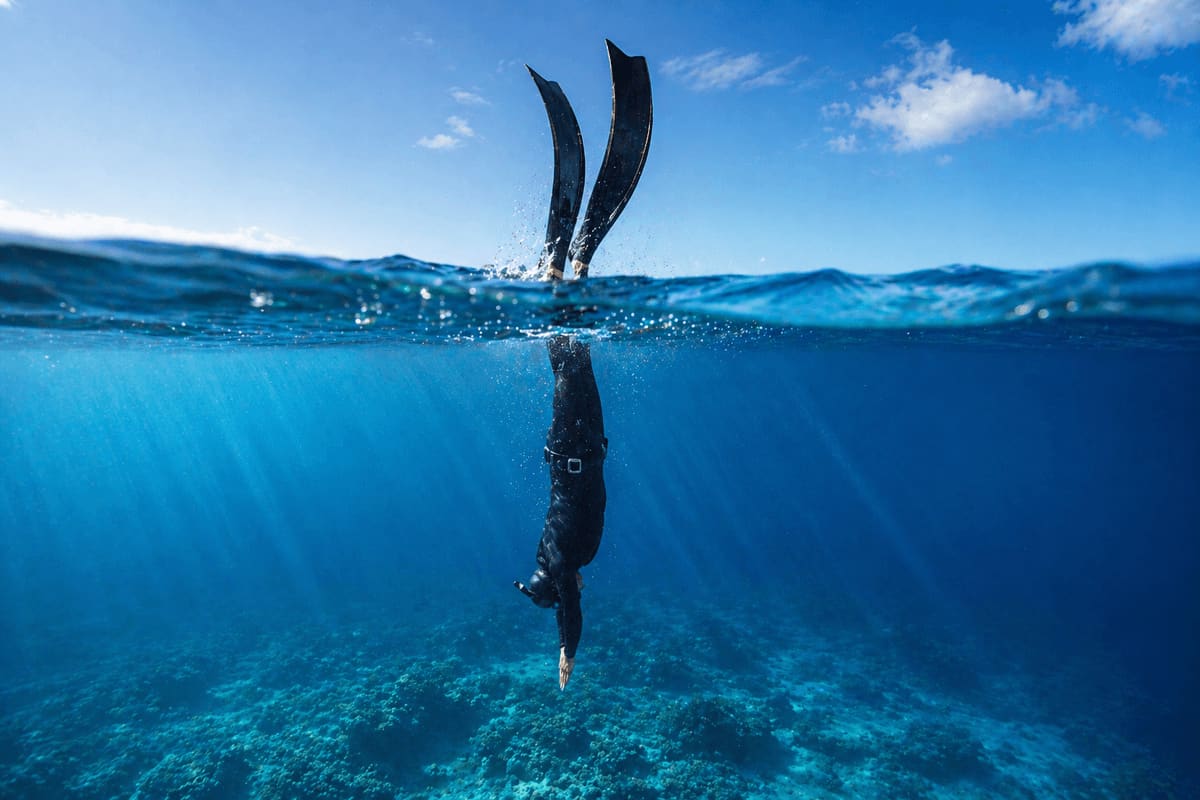

Why Bali belongs in every freediver's itinerary
Bali has something almost no other single destination offers: variety. In a two-hour drive east from Kuta, you can go from a shallow coral-draped WWII wreck to a 30m sand-and-wall dive to a current-swept channel where oceanic sunfish cruise past at 15m. The island's position in the Coral Triangle means biodiversity is exceptional at every site, a reef here that would be a highlight at most destinations is an ordinary Tuesday dive.
The practical case is equally strong. Water temperature stays between 26-29°C at the surface year-round. Gear rental is available at every dive hub. Courses are taught by qualified instructors at prices 20-40% below European or Australian equivalents. And unlike some diving capitals where the infrastructure has outpaced the instruction, Bali's freediving scene has grown around serious practitioners, many of the instructors based in Tulamben and Amed have international competition backgrounds.
The key freediving sites in Bali
Bali has four zones worth building an itinerary around. Each has a different character and a different reason to be there.
Tulamben, the Liberty wreck
The USAT Liberty was a US Army cargo ship torpedoed by a Japanese submarine in 1942 and beached at Tulamben on Bali's northeast coast. In 1963, Gunung Agung erupted and the lava flow pushed the wreck into the sea, where it settled on a sand slope in 3-30m of water. Today it's covered in hard and soft coral, resident fish schools, and enough structure to spend an entire week exploring without repetition.
- Depth range
- 3m (stern, shallow end) to 30m (bow, deepest point). Most freediving happens 5-20m along the main deck and holds.
- Entry
- Shore entry from a black sand beach at Tulamben village. Walk in wearing fins, swim 30m to the site. No boat required.
- Conditions
- Usually calm. Light current. Visibility 15-25m on good days. Best in morning before any swell picks up.
- Best for
- All levels. Beginners explore the 5-12m sections. Intermediate divers work the holds and crane structures at 15-20m. Advanced divers reach the bow at 28-30m.
Nusa Penida: walls, mantas, and mola mola
Nusa Penida is an island 20km southeast of Bali, reached by a 30-45 minute fast boat from Sanur. It offers the most dramatic freediving in the Bali area: current-swept walls dropping to 40m+, open ocean swells, and wildlife that can't be found reliably anywhere else in the region.
- Crystal Bay
- The primary mola mola site. A sheltered bay with a reef wall descending to 40m+. Mola mola (oceanic sunfish) are cleaned by angelfish on the wall, typically at 15-25m. Season runs August-October.
- Manta Point
- Shallow cleaning station at 5-18m where manta rays hover to be cleaned. Freediving mantas here is the highlight of many divers' entire trip. Best in dry season (April-October).
- Gamat Bay
- Sheltered bay with reef in 5-20m. Calmer than the exposed sites, good for skill work and relaxed sessions when swell prevents access to Crystal Bay.
- Conditions note
- Nusa Penida can have significant current and swell, particularly at exposed sites. Not appropriate for beginners. Open-water experience and strong buddy protocol required.
Amed, reef walls and relaxed sessions
Amed is a string of fishing villages on Bali's northeast coast, 20 minutes north of Tulamben. The diving is quieter than Tulamben and the walls here descend to 40m+ from shore at some sites. There's a second wreck, the Japanese shipwreck, in shallow water off the main Amed strip. The atmosphere is low-key compared to south Bali, and several small freediving centers operate in the village.
Menjangan Island: pristine reef, no crowds
Menjangan Island sits off the northwest tip of Bali within West Bali National Park. A 45-minute boat ride from Labuan Lalang. The walls here drop vertically from 2m to 40m+ with exceptional coral cover and visibility that regularly exceeds 30m. It's the least visited of Bali's main freediving areas and consequently the most pristine. Worth the logistics for a day trip.
Freediving courses and centers in Bali
Certified freediving instruction is concentrated in three areas: Tulamben (best for wreck-oriented training), Amed (small-group instruction, relaxed pace), and Sanur (accessible from south Bali, with boat access to Nusa Penida). A handful of instructors also operate from Canggu and Seminyak, though their depth access requires a transfer.
When to go, seasons and site conditions
For a first trip where the priority is reliable conditions and good visibility, April-June is the strongest window. The Bali Sea is at its calmest, the Liberty wreck shows its best visibility, and you avoid both the August peak crowds and the wet season variability.
Getting there and practical logistics
- Flights
- Fly to Ngurah Rai International Airport (DPS), Denpasar. Direct flights from Singapore, Kuala Lumpur, Sydney, Tokyo, and Hong Kong. Connections via Doha, Dubai, Singapore, or KL from Europe and North America. From the US West Coast: 17-20 hours total transit. From Sydney: 6 hours direct.
- Getting to the dive sites
- Tulamben is 2-2.5 hours from Kuta/Seminyak by hired driver, budget ~$30-40 USD one-way for the transfer. Amed is 20 minutes further north. Sanur (for Nusa Penida boats) is 30-45 minutes from the main tourist area. Uber/Grab taxis are available but not recommended for the long north-coast transfers, arrange with your guesthouse or freediving center.
- Accommodation in Tulamben
- Stay in Tulamben village itself. Guesthouses and small hotels run $20-60/night within walking distance of the Liberty wreck entry. Most freediving centers can recommend or book accommodation. Staying on site means dawn dives before the boat divers arrive.
- Equipment
- All standard freediving gear (mask, fins, wetsuit, weight belt) is available for rent from centers in Tulamben and Amed. If you have a fitted low-volume mask, bring it. Long-blade fins check as sports equipment on most airlines, confirm baggage policy before assuming.
- Currency
- Indonesian Rupiah (IDR). Course fees and hotel rates are often quoted in USD; payment in IDR at current rate is standard. ATMs in Tulamben village exist but can be unreliable, bring enough IDR from Denpasar or Candidasa. Most centers accept USD cash.
- Connectivity
- Indonesian SIM cards are inexpensive and available at the airport. 4G coverage is good in Tulamben and Amed. Most dive centers and guesthouses have wifi.
Bali vs Dahab vs the Philippines, which fits your goals?
Choose Bali if the Liberty wreck is on your bucket list or you want exceptional marine life alongside structured course work. The combination of a forgiving shore-access wreck, Coral Triangle biodiversity, and a functioning freediving instructor community makes it the strongest single-destination choice for freedivers who want more than depth progression alone.
Choose Dahab if maximum depth training efficiency is the goal. Shore access to 40m+ without boat logistics, the density of experienced technical instructors, and the depth-obsessed culture mean you'll log more meaningful training dives per day than anywhere else. The Liberty wreck is more interesting; the Blue Hole is more useful for building depth.
Choose the Philippines if tropical island travel is part of the itinerary. Panglao's marine diversity is extraordinary and the relaxed atmosphere makes it genuinely enjoyable beyond the diving. The lack of a site like the Liberty or the Blue Hole is a trade-off most divers accept happily once they're underwater at Balicasag.