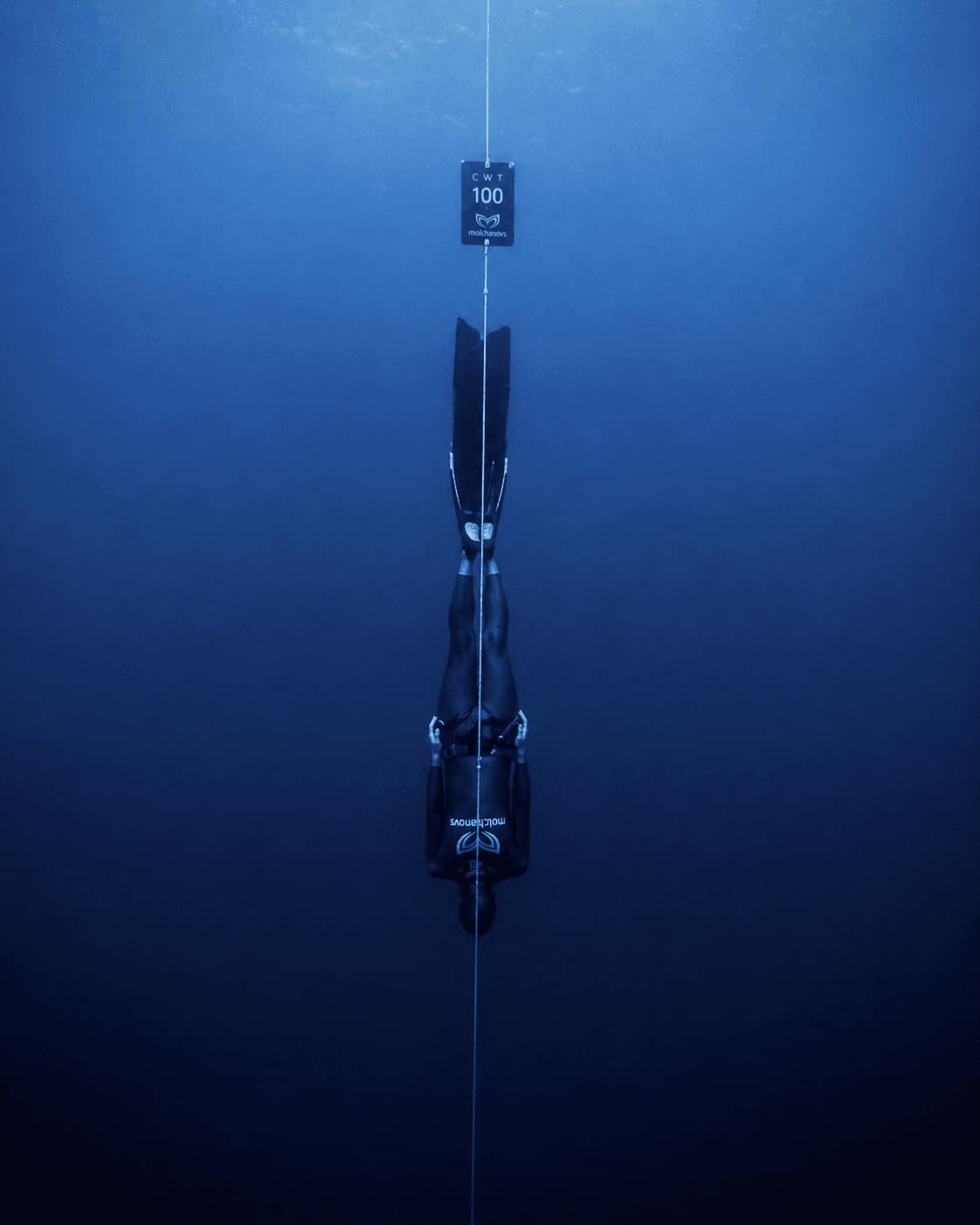

What Counts as a Freediving World Record
Freediving world records mark the extreme edge of human breath-hold capacity. They are useful twice over: as a reference for what the sport can achieve, and as context for where ordinary training sits relative to those limits. Before reading any table, though, it helps to know that the phrase freediving world record covers at least three different things, and mixing them up is the single most common error in coverage of the sport.
A record only means something alongside its rulebook. The same swimming pool, the same athlete and the same breath hold can produce a legitimate 11-minute record or a legitimate 24-minute record depending on whether pure oxygen was breathed beforehand. The same rope in the same bay can produce a 130m dive or a 250m dive depending on whether the diver swims or rides a sled. Each of the disciplines below is a separate event with its own list, and there is no single overall number.
- Competition records: set at sanctioned AIDA or CMAS events, on air only, with judges, safety divers, official depth tags and post-dive surface protocols.
- Historical or unratified marks: real dives that were achieved but not certified, or set in categories the federations have since retired.
- Guinness-style records: single attempts under bespoke criteria, including the oxygen-assisted static apnea figures that dominate search results.
The eight live competition disciplines split cleanly into pool events and depth events, and the tables in this article follow that split. If the discipline abbreviations are unfamiliar, the breakdown in freediving disciplines explains what each one asks of the diver and how they are judged.
Pool Discipline Records: Static and Dynamic Apnea
Pool disciplines remove pressure from the equation. No equalization, no narcosis, no decompression risk, just oxygen economy and carbon dioxide tolerance. That makes them the fairest test of raw apnea ability and the reason they are contested at the Pool World Championship separately from depth.
Static Apnea (STA)
The diver floats face down and motionless, holding a single breath for maximum duration. It is the simplest event to describe and the hardest to endure, because there is nothing to occupy the mind while the urge to breathe builds. Our full guide to static apnea covers the training progressions behind these times.
Both of those are unusually durable records. Mifsud's time has survived more than fifteen years of assault, with several athletes recording holds in the 11-minute range without displacing it, and Molchanova's 9:02 stood as the definitive women's mark long after her death in 2015. Static is the discipline where the human ceiling appears closest, which is exactly why the oxygen-assisted numbers discussed later look so startling by comparison.
Dynamic Apnea with Bi-fins and Monofin (DYN, DYNB)
Horizontal underwater swimming on one breath, measured in metres. DYN allows a monofin, the fastest and most economical option; DYNB restricts the diver to conventional bi-fins and became a separate record category in 2021, which is why its list is shorter and moves faster. The pacing and technique behind both are covered in dynamic apnea.
Dynamic Apnea Without Fins (DNF)
The same event stripped of propulsion aids: breaststroke arms, a dolphin kick, bare feet. DNF punishes any inefficiency in the glide, and the distances are correspondingly shorter than DYN.
Malina is the most complete pool athlete the sport has produced, holding or having held records in every dynamic category at once. Solich-Talanda occupies the same position on the women's side, and between them they account for most of the pool record list of the past decade.
Depth Discipline Records: CWT, CWTB, CNF and FIM
Depth is where the sport's public attention sits, and where the physiology gets genuinely strange. Below roughly 30m a diver is negatively buoyant and sinks without effort; below 60m the lungs have compressed past residual volume and equalization depends entirely on air moved into the mouth before the descent. The four live depth disciplines differ only in how the diver moves, but that difference is worth tens of metres.
Men's depth records
Women's depth records
Trubridge's Constant Weight No Fins records are widely treated as the most impressive line on the whole list. Passing 100m with nothing but bare hands and feet leaves no margin for technical error, and no one has come close to displacing 102m in the years since. If you want the fuller story of how the depth ceiling has been pushed, including the sled dives, see deepest freedive ever.
One thing the depth tables do not show is failure rate. A world record depth attempt is announced in advance, the plate is set at the target depth, and the dive is only valid if the diver surfaces with the tag, remains conscious, and shows no loss of motor control during a 30-second surface protocol. Blackouts and samba at the surface invalidate the dive entirely, which means the published numbers understate how many attempts are actually made at those depths.
The Sled Categories: Variable Weight and No Limits
Two older categories use equipment for part of the dive, and both sit outside the modern competition calendar. They produce the largest depth figures in freediving and cause most of the confusion about how deep a human can actually go.
Variable Weight (VWT)
The diver descends on a weighted sled and then swims or pulls back up unassisted. Because the descent is free of effort, VWT depths exceed constant weight by a comfortable margin. The men's AIDA mark has stood in the mid-140s since Stavros Kastrinakis (Greece) reached 146m in 2015, and the women's mark around 130m from Nanja van den Broek (Netherlands) the same year. AIDA still recognises the category but stages it rarely, so both figures have been static for a decade.
No Limits (NLT)
Descend on a sled, ascend on an inflatable lift bag. With the physical work removed in both directions, the only remaining limits are pressure tolerance and gas dynamics, and the numbers are enormous.
- Men's official mark
- 214m, Herbert Nitsch (Austria), 2007. This was the last ratified No Limits world record and still stands as the official figure.
- Men's unratified deep dive
- Nitsch reached beyond 250m in 2012 off Santorini. He lost consciousness during the ascent, suffered multiple decompression hits and serious neurological injury, and spent months relearning to walk. The dive is widely cited but was never certified as a record.
- Women's mark
- 160m, Tanya Streeter (Cayman Islands/UK), 2002. Streeter also held the outright No Limits record ahead of every man at the time, which remains one of the sport's most remarkable results.
AIDA, CMAS and Guinness: Why There Is More Than One Record
Search for a freediving record and you will find competing numbers for the same event. That is not sloppy reporting, it is the consequence of three bodies certifying dives under three sets of rules.
- AIDA International
- Founded in 1992 and the federation most competitive freedivers organise around. AIDA sets the discipline definitions used throughout this article, runs the Pool and Depth World Championships, and maintains the record list that athletes and media generally treat as the reference. Records require a sanctioned event, AIDA judges, announced targets and a clean surface protocol.
- CMAS
- The World Underwater Federation, older than AIDA and responsible for a parallel record list. CMAS rules differ in details such as permitted warm-ups, apparatus and event formats, and it also sanctions disciplines AIDA does not. The result is that two athletes can each hold a legitimate world record in nominally the same event with different distances or depths, and neither is wrong.
- Guinness World Records
- Not a sporting federation. Guinness certifies one-off attempts against criteria it negotiates with the applicant, which is how oxygen-assisted breath holds, ice-water statics and under-ice distance swims get recognised. These entries make excellent headlines and are not comparable with competition records.
Practical rule for reading any figure you come across: check the discipline abbreviation, check the sanctioning body, and check whether the attempt used supplemental oxygen. If a source gives none of the three, treat the number as decoration.
The 24-Minute Breath Hold and Why It Is a Separate Record
The most-searched freediving breath hold world record figures are the oxygen-assisted ones, and they deserve a section of their own because they are so easy to misread. Budimir Sobat (Croatia) held 24 minutes 37 seconds in 2021, and the mark has since been driven past 29 minutes. Meanwhile the AIDA competition record sits at 11:35. Both numbers are honest.
The difference is pre-oxygenation. In a Guinness oxygen-assisted attempt the athlete breathes pure oxygen for up to half an hour beforehand, saturating blood and lung volume far past what air breathing allows and dramatically extending the time before hypoxia forces a surface. It is a genuine feat of carbon dioxide tolerance and mental control, and the athletes doing it are elite. But it tests something different from an air-only hold, and it tells you nothing about how long that athlete could stay down on a dive.
Notice the third row. Record depth dives are short. A 130m dive takes around three and a half to four and a half minutes, nowhere near a static maximum, because working muscles burn oxygen far faster than a motionless float does. If you are curious what realistic air-only progress looks like for a trained diver rather than a record holder, how long can you hold your breath works through the numbers.
The Athletes Behind the Numbers
A surprisingly small group accounts for most of the current record list. Understanding who they are makes the table read less like trivia and more like a sport.
- Alexey Molchanov (Russia)
- The dominant depth athlete of the modern era, holder of the deepest constant weight and free immersion marks and founder of the Molchanovs education system. Son of Natalia Molchanova, and the athlete who normalised depths past 125m.
- Natalia Molchanova (Russia)
- The most decorated freediver in history with more than forty world records across pool and depth, and the first woman past 100m. She disappeared during a recreational dive off Ibiza in 2015. Several of her records survived for a decade after.
- Alessia Zecchini (Italy)
- The leading women's depth athlete since the late 2010s, holding or contesting records in all four depth disciplines and the first woman to pass 110m in constant weight.
- William Trubridge (New Zealand)
- Two-time world champion and the definitive no-fins diver, whose 102m CNF record from 2016 has proven the hardest number on the list to beat. Also the driving force behind Vertical Blue, the event where a large share of depth records are set.
- Herbert Nitsch (Austria)
- Held records in every discipline at various points and earned the nickname the deepest man on earth for his sled dives. His 2012 accident past 250m ended his record career and effectively ended No Limits as a category.
- Stephane Mifsud (France)
- Set the men's AIDA static apnea record of 11:35 in 2009, a time that has outlasted almost every other record in the sport.
- Mateusz Malina (Poland)
- The most versatile pool athlete of the era, with records across dynamic with fins, bi-fins and no fins, plus a share of the first 300m dynamic dive.
- Magdalena Solich-Talanda (Poland)
- The women's counterpart in the pool, holding dynamic and dynamic no-fins records and repeatedly extending her own marks.
- Arnaud Jerald (France)
- Effectively the owner of the bi-fins depth category since 2019, having broken the men's CWTB record numerous times and pushed it into the 120s.
- Petar Klovar (Croatia)
- The athlete who has moved the men's dynamic records past the long-standing 300m barrier in recent seasons.
- Fatima Korok (Hungary)
- The strongest recent challenger in women's depth, trading bi-fins and no-fins marks with Zecchini.
"The limit is not in the lungs. It is in how long the mind stays quiet while the body says otherwise."
How the Records Progressed
In the early 1960s physiologists calculated that lung compression would crush the chest and kill a diver somewhere around 50m, and the medical consensus was that deep breath-hold diving was a dead end. Enzo Maiorca and Jacques Mayol proceeded to ignore this, and the discovery of blood shift, where plasma moves into the thoracic cavity to fill the compressing space, dismantled the theory entirely.
Three shifts explain most of the curve. Equalization technique came first: Valsalva gives out around 30m, Frenzel extends the range considerably, and the mouthfill method allows a diver to keep equalizing well past the depth at which the lungs can supply air at all. The mechanics of that last step are covered in the mouthfill technique.
Second, training became systematic. Where 1980s divers largely improvised, today's record holders follow periodised annual plans with distinct base, CO2 tolerance and depth phases, the same structure described in breath hold training. Third, safety infrastructure improved: counterballast systems, deep safety divers on scuba, sonar tracking and standardised surface protocols mean athletes can attempt near-limit dives with a realistic rescue plan, which changes what they are willing to attempt.
The rate of improvement is slowing. Depth records now move by one or two metres at a time rather than five or ten, and the no-fins record has not moved since 2016. That pattern usually indicates a discipline approaching a physiological wall. Current records are still unlikely to be the final answer, but the era of ten-metre leaps looks finished.
What It Takes Physically to Reach These Numbers
The numbers in the tables are not the product of a big chest and courage. They rest on a set of specific, trainable adaptations, most of which take years rather than months.
- 01 —Equalization capacity. Past roughly 60m the lungs hold too little air to inflate the ears, so the diver charges the mouth with a fixed volume of air at depth and manages it all the way down. Mouthfill takes most athletes two or three years to make reliable, and it is the single most common reason a deep attempt is aborted.
- 02 —Thoracic and diaphragm flexibility. Record divers spend years on stretching protocols that let the ribcage and diaphragm deform without injury at pressures where the lungs are compressed well past residual volume. Skip this and lung squeeze appears long before the target depth.
- 03 —A strong mammalian dive reflex. Bradycardia into the 10-20 bpm range, peripheral vasoconstriction that reserves blood for heart and brain, blood shift into the chest, and spleen contraction releasing extra oxygen-carrying red blood cells. The reflex is innate but its magnitude improves substantially with regular cold-water exposure and training.
- 04 —Carbon dioxide tolerance. The urge to breathe is a CO2 signal, not an oxygen one. Tolerance training changes how much of a dive a diver can spend in discomfort without panic, which is why static specialists talk more about pain management than about lung volume.
- 05 —Efficiency and relaxation. Every unnecessary movement costs oxygen. Elite technique is defined by a long passive sinking phase, minimal finning, and a heart rate that drops rather than climbs on the descent.
- 06 —Base fitness and body composition. Aerobic conditioning, low resting heart rate and a body that is not fighting buoyancy all matter, but they are enablers rather than differentiators at the top of the sport.
None of that is accessible without a coach and a structured multi-year plan, which is the honest reason the record list is short. It is also the reason record depths are irrelevant as personal targets. What a diver can safely do is bounded by their equalization and their squeeze risk, not by their ambition, and how deep can you freedive sets out realistic bounds for a diver without that infrastructure.
Where Recreational Divers Fit
Placing yourself on the same scale as the record holders is useful, as long as the conclusion you draw is proportion rather than inadequacy. The table below reflects typical outcomes for divers training consistently with instruction.
Two things stand out. First, the depth column spans a factor of twenty from beginner to record holder, while the static column spans a factor of about six, which tells you how much of depth performance is technical rather than metabolic. Second, most of the sport happens in the top four rows. Recreational freediving, meaning reef exploration, marine life observation and spearfishing, takes place at depths that require none of the extreme adaptation record holders develop.
Keeping the Numbers Current
Any records article goes stale, this one included. The authoritative source is the AIDA International records list, which publishes ratified marks by discipline and gender, with CMAS maintaining its own parallel list. Most depth records appear first at three events: Vertical Blue at Dean's Blue Hole in the Bahamas, the Caribbean Cup in Honduras, and the AIDA Depth World Championship. Pool records cluster around national championships and the AIDA Pool World Championship.
When you see a new figure reported, three checks separate a real record from a headline. Was it set at a sanctioned competition under a named federation, was the depth tag retrieved and the surface protocol clean, and is the discipline stated precisely, including whether fins were used and which kind. A dive announced on social media the same day it happened is usually accurate but not yet ratified, and occasionally the ratification does not come.
Records are the sport's shop window, not its substance. The interesting part is that the numbers keep moving in a sport whose limits have been declared final at least four times, and that the same physiology producing 131m dives is the physiology that lets a beginner stay comfortable at 12m after a weekend course.