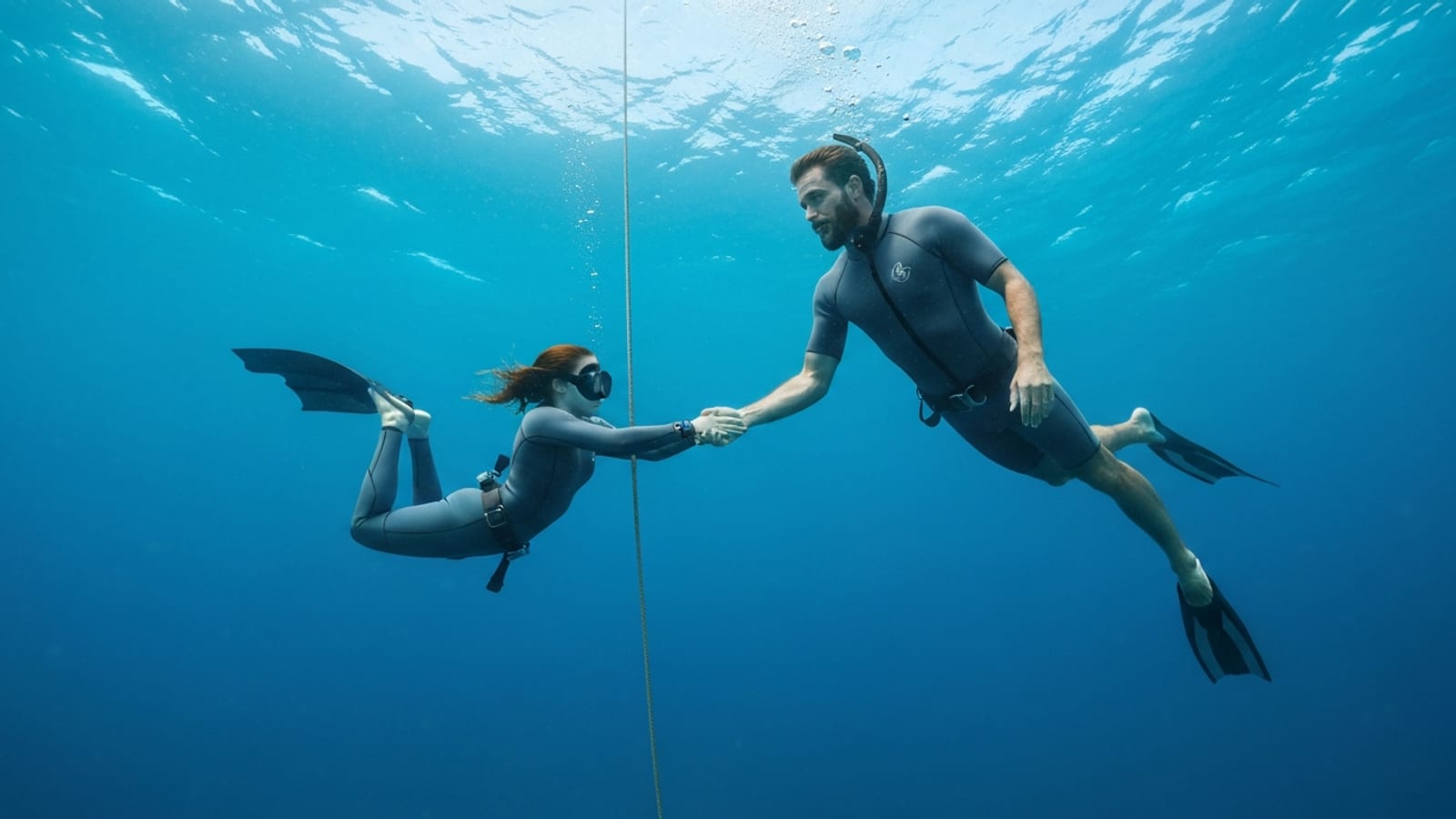

AIDA vs PADI: one philosophy split
AIDA and PADI are the two names a new freediver hears most, and the question of which to pick comes up in every beginner's first week. The honest answer is that both teach the same physiology, the same equalization techniques, and the same buddy safety rules. The difference is character. AIDA International was founded in 1992 as a competition body and still treats measurable performance as the backbone of every certification. PADI built its Freediver program as a recreational ladder, designed to be taught at the same resorts that already run its scuba courses. If you are still deciding whether freediving is for you at all, start with what freediving actually is before you book anything.
Neither approach is better in the abstract. A competitor who wants documented numbers and a clear path to deeper diving is served well by AIDA. A traveler who wants to certify on a dive trip and may already hold a PADI scuba card is served well by PADI. Most of this article is about telling those two divers apart so you can place yourself in the right one.
How the courses are built
Every entry-level course in this comparison follows the same three-part shape: classroom theory, confined-water or pool sessions for breath-hold and skills, and open-water sessions for depth. What changes between agencies is how rigid the performance bar is and how the materials are delivered.
- AIDA
- Standards-driven and performance-led. Each level has fixed minimums for static, dynamic, and depth that you must hit to pass. Theory is solid but the course is built around demonstrated numbers. Strong reputation in competition circles and Mediterranean schools.
- PADI
- Modular and recreational. Uses PADI's digital eLearning platform and a familiar structure that scuba divers recognize instantly. Performance requirements exist but the framing is comfort and progression rather than competition. Widest availability by far thanks to the scuba network.
- SSI
- Very similar to PADI in feel: free digital app, dive-center delivery, depth-banded levels. Backed by a large global dive network and often the most affordable of the resort-style options.
- Molchanovs
- The most education-heavy program. Founded by the family of champion Natalia Molchanova, it splits into Wave courses (open water) and Lap courses (pool only), with deep theory and a strong training-method focus.
Levels and depth, side by side
This is where the comparison gets concrete. The table below lines up the beginner and intermediate levels so you can see how close the agencies actually are on depth. The numbers matter when you are picking a school and when you want to train toward a specific target.
Read the table and the headline is clear: AIDA and PADI land in almost the same place at every tier. AIDA's entry level asks for a verified 16m dive, while PADI certifies at 10m and trains you toward 16m. By the advanced level both top out around 32 to 40m with near-identical static and dynamic minimums. The depth you reach depends on your equalization and relaxation, not the badge.
AIDA level breakdown
- AIDA 1
- A one-day introduction. Basic relaxation, first static holds, finning and duck dives, buddy safety. No performance minimums.
- AIDA 2
- The real beginner certification. Requires 16m constant weight, 2:00 static, 40m dynamic, and a written exam. Max training depth 20m. This is the AIDA course most people mean when they say they got certified.
- AIDA 3
- Intermediate. Requires 24m constant weight, 2:45 static, 55m dynamic. Introduces deeper line work and rescue from depth. Max training depth 30m.
- AIDA 4
- Advanced. Requires 32m constant weight, 3:30 static, 70m dynamic. Covers mouthfill equalization, advanced physiology, and deeper risk management.
PADI level breakdown
- PADI Freediver
- The flagship beginner course. Certify with a 10m constant-weight dive, 90-second static, and 25m dynamic, with training aimed at 16m. Two days at most dive centers.
- PADI Advanced Freediver
- Builds toward 16 to 24m constant weight, 2:30 static, and 50m dynamic. Introduces free immersion and more structured depth work.
- PADI Master Freediver
- Targets 24 to 40m constant weight, 3:30 static, and 70m dynamic. The top recreational tier and a close match to AIDA 4 on the numbers.
Where SSI, Molchanovs, and CMAS fit
AIDA and PADI dominate the conversation, but three other names come up constantly and deserve a fair look, especially if you are searching for schools near you and want to know what a given certification means.
SSI Freediving is the closest thing to a PADI alternative. It uses a free digital app, runs through a large global dive-center network, and bands its levels by depth: Level 1 to 20m, Level 2 to 30m, then deeper. In practice the experience feels much like PADI, and SSI is frequently the most affordable of the resort-style agencies because its course materials are free to students.
Molchanovs is the education specialist. Founded by the family of the late Natalia Molchanova, the most decorated competitive freediver in history, it carries serious credibility and the deepest theory of any program here. Its split between Wave courses (with open-water depth) and Lap courses (pool only) is genuinely useful if you live far from the sea and want to train seriously in a pool. Wave 1 targets 12 to 20m, Wave 2 reaches 24 to 30m, and Wave 3 builds toward 34 to 40m.
CMAS is the federation body. It is the international federation recognized by the Olympic movement, and it certifies through national diving federations using a one-to-four-star system. You will encounter CMAS most often in Europe and in club or federation settings rather than at a typical tourist dive shop. The training is rigorous, but availability is patchier than the commercial agencies for a casual beginner.
"The agency sets the standard. The diver and the instructor set the result. Instructors who teach across several of these bodies make the same point: the card on the wall does not predict who will be the better freediver a year later."
Which agency actually fits you
Stop comparing logos and start comparing situations. The four scenarios below cover most new freedivers, and the right pick falls out quickly once you know which one you are.
- 01 —You want the convenient, travel-friendly path and may already dive scuba. Choose PADI or SSI. They are everywhere, the digital materials are polished, and PADI in particular integrates with a scuba ecosystem you may already use.
- 02 —You want documented performance and a clear road toward competition or deep diving. Choose AIDA. The fixed minimums at each level mean your card reflects verified ability, which matters in competition and Mediterranean schools.
- 03 —You live far from open water or want the deepest understanding of technique and physiology. Choose Molchanovs, and consider a Lap course if you only have pool access.
- 04 —You are training through a national federation, a club, or want Olympic-recognized credentials. Choose CMAS, accepting that you may need to find a participating federation rather than a tourist shop.
If you are choosing a place to learn, two of the best-value freediving hubs in the world are Bali and the Philippines, where you will find AIDA, PADI, SSI, and Molchanovs schools within a short ride of each other.
Cost, recognition, and switching later
Two practical worries come up after the philosophy debate is settled: what it costs, and whether you are locked in. Neither should keep you up at night.
On cost, the agency is almost irrelevant. A two-day beginner course runs roughly 150 to 550 USD, and the spread is driven by location, not logo. Schools in major cities and high-cost countries sit at the top; dive hubs in Southeast Asia and parts of the Mediterranean sit at the bottom. SSI often edges out the others slightly because its student materials are free, but the difference is small next to the swing from city to dive town.
- Global recognition
- All five are internationally recognized. PADI has the widest physical footprint through scuba, AIDA is the standard in competition and many Mediterranean schools, SSI and Molchanovs are globally accepted, and CMAS carries federation and Olympic recognition.
- Crossover
- No formal automatic equivalency exists between agencies, but the levels line up closely enough that it rarely matters. A PADI Freediver who dives 16m has the foundation for AIDA 3 or SSI Level 2.
- How schools place you
- Most instructors assess your actual in-water skills, not your card. Bring proof of certification and be honest about recent depth experience, and you will be placed correctly regardless of which agency you started with.