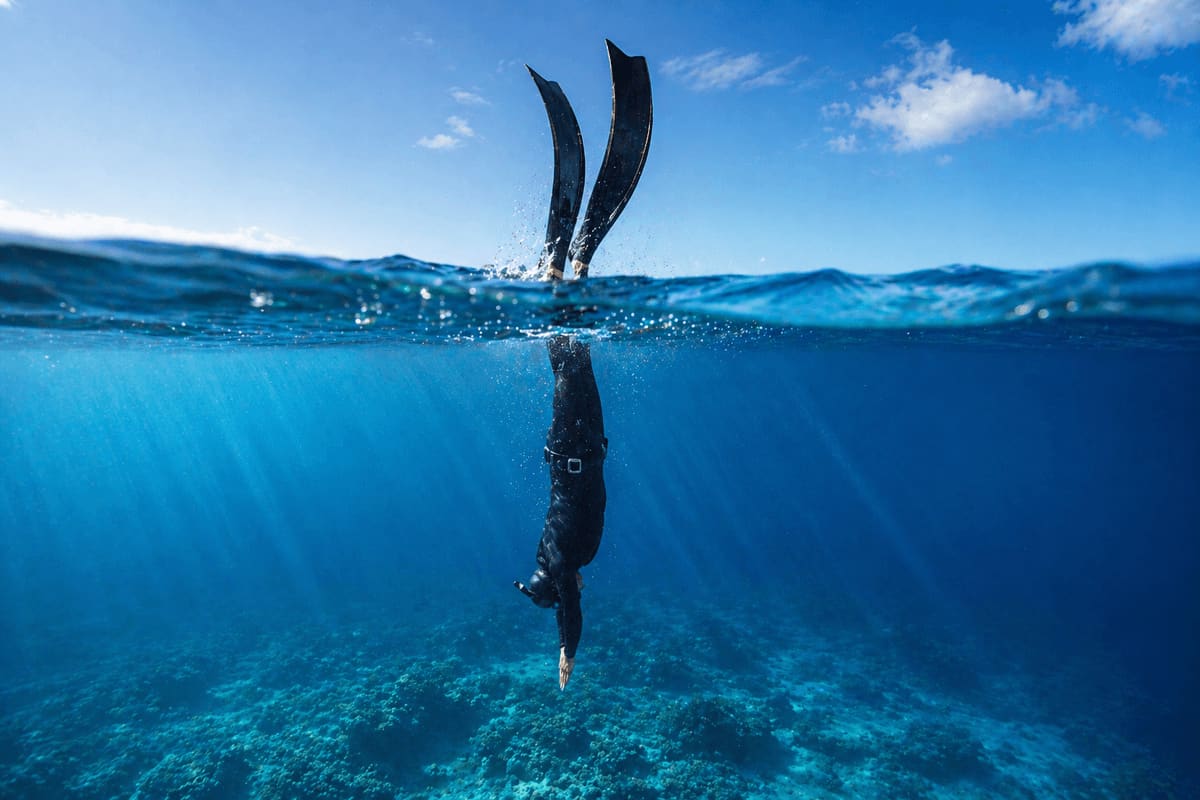

Why Hawaii is in a different category for freediving
Hawaii sits in the middle of the Pacific Ocean, surrounded by some of the clearest water on Earth. The islands are the above-water peaks of enormous volcanic mountains, and the underwater topography reflects this. Lava tubes, arches, sheer walls, and caverns create dive site complexity that coral-and-sand destinations cannot replicate. Kona's coast drops steeply into deep Pacific water within a few hundred meters of shore, which means quick access to 30m+ depths without a boat and without the gradual shallow-water approach that most reef destinations require.
The water is warm year-round. Surface temperatures range from 24°C in winter to 27-28°C at the summer peak. There is no dead season for freediving in Hawaii the way there is for most other quality destinations. Visibility is exceptional: 25-35m at standard Kona sites, hitting 40m at Kealakekua Bay, a marine sanctuary that has seen minimal fishing pressure for decades. And Hawaii offers experiences unique in the Pacific: manta rays that reliably appear at night, spinner dolphin pods that rest in specific protected bays, and open-ocean black water dives over genuinely deep water.
Kona and the Big Island: Hawaii's freediving capital
The Kona coast runs down the western side of the Big Island for approximately 100km. The island is a shield volcano. Underwater, this means the coast drops steeply into deep Pacific water with minimal shallow shelf. From shore, you can be over 30m of water within minutes. The lava topography creates a freediving environment unlike any reef system: walls, archways, lava tubes of varying sizes, and boulder fields that harbor turtles, moray eels, and dense reef fish populations.
Two Step (Honaunau Bay)
Two Step is arguably the best shore-entry freediving site on the Big Island. The name comes from the two natural rock steps that provide the entry point into the water. Visibility regularly exceeds 30m. The site has easy entry, immediate drop to 10-25m, and consistently strong marine presence: green sea turtles, butterflyfish, parrotfish, octopus, and the occasional white-tip reef shark. This is the first site most Kona-based instructors take new freedivers to, and it repays repeat visits. Honaunau Bay extends south into deeper water. The drop-off begins almost immediately from the Two Step entry.
Kealakekua Bay marine sanctuary
Kealakekua Bay is a steep-walled bay 8km south of Kailua-Kona. It is a state marine life conservation district: no fishing, minimal boat traffic. The combination of these protections over decades has produced exceptional marine density. Visibility hits 40m in ideal conditions. Spinner dolphins use the bay as a daytime rest area; freediving at depth while a pod of spinners circles is among the most memorable Pacific dive experiences. The site is accessed by kayak (no dock entry on the north shore) or by boat tour from Kailua-Kona.
- Manta Ray Night Dive at Garden Eel Cove
- Garden Eel Cove (also called Manta Village) sits north of Kailua-Kona Airport. Lights from boats and shore attract plankton after dark, which attracts manta rays. The mantas filter-feed in the illuminated water column, often passing within arm's reach of freedivers. Encounters are highly reliable: locals describe missing a manta on a given night as unusual rather than expected. The site is shallow (3-10m) and accessible for all experience levels. This is one of the most extraordinary wildlife encounters available anywhere in the Pacific, and freediving rather than scuba means no bubbles, a quieter experience.
- Kailua Pier
- The historic Kailua Pier is the finish of the Ironman World Championship swim. The adjacent reef system has excellent fish density. This is one of the most accessible dives from town. Easy water entry from the pier, decent visibility, and regular appearances by larger pelagics attracted to the activity around the pier. Good for an easy drift or an evening pre-manta-dive warm-up.
- Puako Bay
- Puako is 30km north of Kailua-Kona. The bay has a shallow reef shelf with lava tubes, arches, and patchwork coral reefs accessible from shore. Depths from 5m to 25m. Less trafficked than Two Step, consistent visibility, and resident turtle population. A good quiet-day alternative when the primary Kona sites are busy.
- Black water freediving (offshore)
- Several kilometers offshore from Kona's coast in the dark, over hundreds of meters of Pacific ocean. Vertical migration of deep-sea organisms produces encounters with larval fish, transparent squid, jellyfish, and species normally confined to the deep. Hawaii's water clarity makes the experience particularly intense: the blackness below is absolute. Recommended only for experienced freedivers. Some Kona operators run guided black water trips.
- Makalawena Beach
- A remote lava-coast beach accessible only by foot (approximately 2km over rough lava field from the road) or by kayak. The isolation means pristine conditions: consistently excellent visibility, minimal snorkeler and tourist pressure. The reef has strong marine presence and there are areas of deeper water for intermediate freedivers. Bring everything you need as there are no facilities.
Maui: Molokini Crater and Honolua Bay
Maui is Hawaii's second-most-visited island and has accessible freediving at several sites. The landmark site is Molokini Crater, a crescent-shaped partially submerged volcanic crater 5km off Maui's southwest coast. The crater creates a protected natural bowl with 20-30m visibility and dense marine life. The inner crater is shallow (3-15m); the outer wall drops steeply to 30m+ and beyond. Molokini sees significant boat traffic in the morning. Early start or off-season visits produce better conditions.
- Molokini Crater
- Boat trip from Ma'alaea or Kihei (approximately 45 minutes). The inner crater bowl is excellent for beginners and warm-ups: shallow, clear, dense reef fish. The back wall (Molokini's outer face) drops to 30m and continues beyond. Visibility inside the crater is typically 20-25m; outside in the channel it can be clearer. Most Maui operators run morning snorkel/freedive boats to Molokini.
- Honolua Bay
- A protected bay on Maui's northwest tip with a coral reef shelf descending to 15-20m. Visibility is typically 15-20m. The bay is best in summer (calmer north shore conditions); winter northwest swells can make it rough. Shore access is via a short trail from the road. Strong marine presence including spinner dolphins at times, turtles, and good reef fish density.
- Makena (Big Beach) drop-off
- South Maui near Makena has a reef drop-off accessible from shore in 5-20m with turtles and good visibility (15-25m on calm days). Less trafficked than Molokini and accessible without a boat. A solid day-trip option for freedivers based in Kihei or Wailea.
Oahu: Sharks Cove and accessible lava tube freediving
Oahu is the most populous Hawaiian island and home to Honolulu. Freediving infrastructure here is geared toward recreational beginners and certification students rather than serious depth training. The best Oahu freediving site, Sharks Cove on the North Shore, is one of the more interesting lava tube systems in Hawaii for intermediate freedivers, with caverns and swim-throughs accessible without specialized equipment.
- Sharks Cove (North Shore)
- Despite the name, Sharks Cove has no unusual shark activity. The name comes from the rocky cove shape. The site is one of Oahu's best shore-entry dives: an intricate system of underwater lava tubes, caverns, and swim-throughs with entrances at various depths (3-10m). Average depth at the site is 5-9m, with some tubes descending to 10-12m. Best in summer (May-September) when North Shore swells are minimal. In winter, large northwest swells make the site undiveable. Visibility is typically 10-20m.
- Hanauma Bay
- Hanauma Bay is Oahu's famous marine sanctuary near Hawaii Kai. The bay is a snorkeler's site: shallow (1-7m), heavily trafficked, and not suited to serious freediving. But it is worth mentioning for beginners who want flat-water, calm introduction to Hawaiian reef species before moving to deeper sites. Entry requires a small fee and an environmental orientation video. Water entry by beach walk.
- Waikiki nearshore reefs
- Several reef structures are accessible from Waikiki beach with moderate fin swims (200-500m from shore). Depths of 5-15m with turtles and reef fish common. Visibility is typically 10-15m. Not a quality freediving destination but accessible for a quick session when based in central Honolulu.
Freediving courses and centers in Hawaii
Hawaii's dedicated freediving instruction is concentrated on the Big Island (Kona). Oahu and Maui have PADI and SSI freediving courses primarily offered by scuba centers adding freediving as a secondary service. The FII (Freediving Instructors International) system, used by dedicated performance-focused freediving schools globally, is represented in Hawaii only through Kona Freedivers.
When to go: Hawaii's year-round advantage
Hawaii's primary competitive advantage over every other quality freediving destination is that it has no bad season. Water temperature varies from 24°C in February to 27-28°C in August, a 3-4 degree swing versus the 10-15 degree swings at Mediterranean or temperate Atlantic sites. You do not need to plan around seasonal windows the way you must for Greece, Croatia, or even Florida.
Getting there and practical logistics
- Flights: Big Island
- Kona International Airport (KOA) has direct flights from Los Angeles, San Francisco, Seattle, Denver, and Phoenix, plus connections from other US hubs. Most mainland US direct flights are 5-6 hours. From outside the US, connect through Los Angeles or San Francisco. Do not route through Honolulu if your destination is Kona: the inter-island flight adds time and cost unnecessarily when direct KOA routes exist.
- Getting around the Big Island
- A rental car is essential on the Big Island. The island has no meaningful public transport and the main freediving sites (Two Step, Kealakekua Bay, Puako, Makalawena) are spread along a 60km stretch of coast. Book a rental car before you arrive. Kona rental availability drops quickly in peak season. A 4-wheel-drive is not necessary for most freediving sites, but Makalawena Beach requires parking and walking over rough lava, not offroading.
- Accommodation
- Kailua-Kona town is the central hub for Big Island freediving. Vacation rentals (Airbnb, VRBO) are the standard option and run $100-200/night for a one-bedroom unit in Kona. Hotels exist at all price points. For freediving access, staying anywhere in the Kailua-Kona to Captain Cook corridor puts you within 20-30 minutes of Two Step, Kealakekua Bay, Garden Eel Cove, and the pier.
- Equipment
- Kona Freedivers has equipment for course students. If bringing your own gear, Hawaii is a standard airline destination with no restrictions on long-blade fins as checked sports equipment. A 3mm open-cell wetsuit is appropriate for summer; a 5mm is more comfortable for extended winter sessions or black water diving where you are stationary in 24°C water for extended periods. Bring your own low-volume mask: rental options at scuba shops are typically high-volume recreational masks unsuited to freediving.
- Costs
- Hawaii is a US state: costs reflect mainland US pricing, not Southeast Asia. Budget $200-350/day for accommodation, food, car rental, and site fees. Course costs are higher than equivalent certifications in Bali, Mexico, or Egypt. The trade-off is no international flight (for US-based divers), year-round conditions, and some of the most unique freediving experiences in the Pacific.