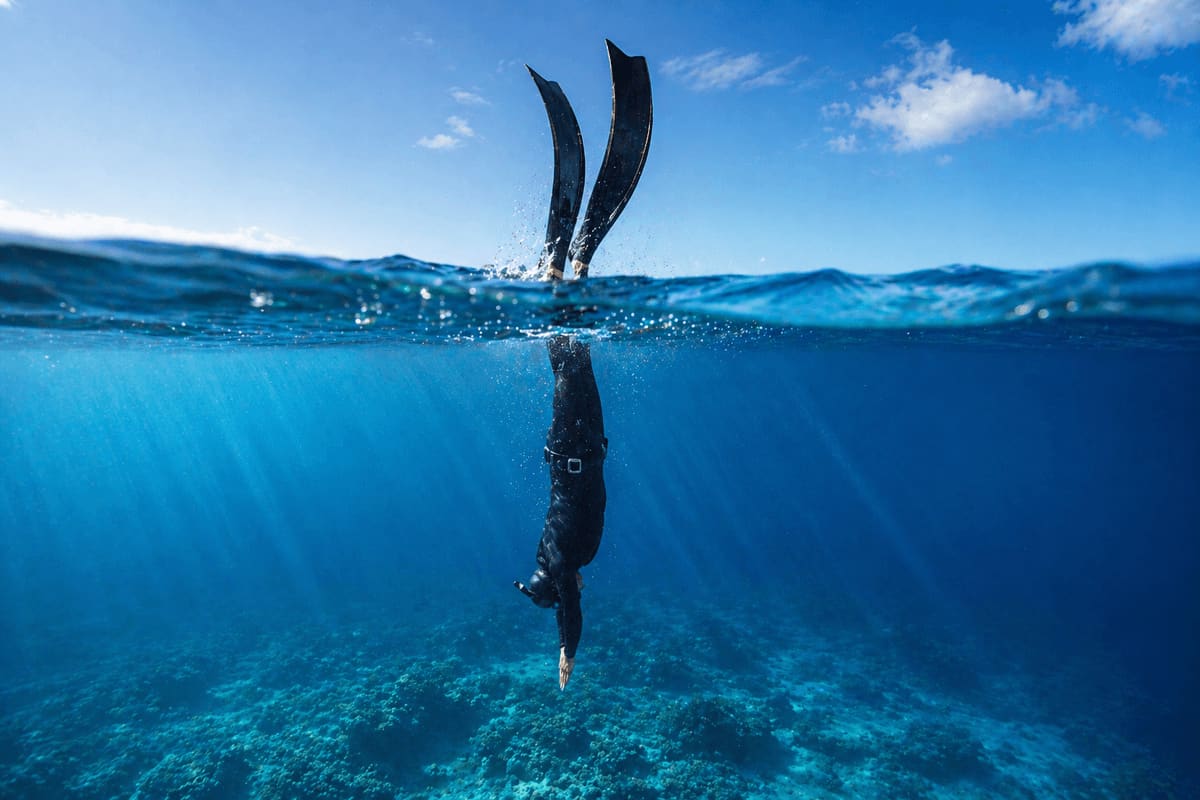

Florida, the US freediving capital
Florida is the most accessible year-round freediving destination in the continental United States. It offers two completely different environments: the warm, saltwater coral reef systems of the Florida Keys in the south, and the inland spring systems of north-central Florida, some of the clearest, most unusual water on the planet. Neither environment has a direct equivalent anywhere else in the country.
The Keys give you tropical reef diving, clear visibility, and water warm enough for a shorty or rash guard in summer. The springs give you constant 20°C freshwater with visibility measured in meters, freshwater cave systems, and in winter, manatee encounters that no scuba diver can match for intimacy. Serious Florida freedivers eventually establish a routine that covers both zones across the year.
The Florida Keys, warm saltwater reef diving
The Florida Keys is an island chain extending 180 miles southwest from Miami into the Gulf of Mexico. The reef system along the ocean side, the Florida Reef Tract, is the only living barrier coral reef in the continental United States and the third-largest barrier reef system in the world. Water temperature runs 24-29°C. Depths accessible to freedivers range from 3m at shallow patch reefs to 25-30m at the outer reef edge.
Key Largo, Christ of the Abyss and Pennekamp
Key Largo is where most freediving visitors start. John Pennekamp Coral Reef State Park contains Christ of the Abyss, a nine-foot bronze statue of Christ placed at 8-9m depth in 1965. It is shallow enough for any freediver to reach on a single breath but surrounded by clear water, healthy coral, and schooling fish that make it one of the most photographed underwater sites in the world. Dive boats run daily from Key Largo marinas.
- Christ of the Abyss
- Bronze statue at 8-9m depth. Shore-accessible by boat from Key Largo. Visibility typically 10-20m+. Good coral and fish life around the base. Year-round access.
- Molasses Reef
- Outer reef spur-and-groove system at 5-12m average depth, dropping to 20m at the seaward edge. High fish density. Moderate current possible on the outer edge.
- French Reef
- Cave and cavern formations at 5-18m, good for intermediate freedivers. Swim-throughs and overhangs with resident goliath grouper and moray eels.
- Benwood Wreck
- WWII freighter at 4-17m, about 7 miles north of Key Largo. Broken into sections across a sand bottom. Accessible for beginner-intermediate freedivers.
Looe Key, the best reef in the Keys
Looe Key National Marine Sanctuary near Bahia Honda (Mile Marker 28) is widely considered the best reef diving in the Florida Keys. The spur-and-groove coral formations at 3-10m are among the healthiest in the system, with exceptional fish life and visibility that regularly reaches 25m+. Day trips run from Big Pine Key.
Key West wrecks and reefs
Key West offers the Vandenberg, a 523-foot military transport ship sunk as an artificial reef at 18-45m. The upper superstructure sits at 18-22m, within freediving range. Extremely large fish, encrusting coral, and a sense of scale unlike most reef dives. Boat trip required from Key West marinas.
Florida Springs, freshwater freediving unlike anywhere else
Florida's spring systems are formed by groundwater pushed to the surface through the limestone karst. The result is water filtered through hundreds of meters of rock, so clear that visibility often exceeds 30m, sometimes 60m in the best conditions. The constant temperature is 20°C regardless of season. And some springs open directly into underwater cave systems that trained cave divers explore for miles.
Ginnie Springs, the flagship freediving spring
Ginnie Springs in High Springs is a private spring park with seven separate springs along the Santa Fe River. The main spring boil is 3-5m deep with visibility above 30m in most conditions. The spring run flows clear and gin-colored, the name is literal. The cavern zone at Ginnie's main cave is a freediving highlight: you can see 15-20m into the cave entrance from the cavern zone while hovering at the surface.
- Ginnie Spring main boil
- 3-5m depth, 30m+ visibility, constant 20°C. Shore access within the park. Freediving permitted throughout the spring run and cavern zone.
- Devil's Eye and Devil's Ear caves
- Two separate cave entrances at Ginnie, among the most explored cave systems in the world. The cavern zone is freediveable; the cave proper requires full cave certification. The view into the entrance from cavern depth is extraordinary.
- Park access
- Day use fee per person. Camping and lodging available on site. Gear rental not available, bring your own. Located near High Springs, 2.5 hours from Orlando, 1 hour from Gainesville.
Devil's Den, prehistoric spring in a cave
Devil's Den near Williston is a prehistoric spring hidden inside a dry cave. You descend stone steps through a hole in the cave roof and emerge on a wooden platform above an underground lake. The water is 21°C, visibility exceeds 30m, and the cave ceiling rises 9m above the water. The central pool reaches 30m depth, making it one of the best depth training sites in Florida for freshwater.
Crystal River and Kings Bay, manatees
Crystal River on Florida's Gulf Coast is the center of the state's manatee ecotourism industry. Kings Bay hosts the largest winter concentration of West Indian manatees in the United States, hundreds of animals from November through March when water temperature drops outside and manatees seek the constant 22°C spring water. Freediving with manatees here is one of the genuinely unique wildlife experiences available in the US. No scuba, the bubbles disturb the animals.
Blue Grotto, best depth training in fresh water
Blue Grotto near Williston is a privately operated freshwater sinkhole with a cavern reaching 30m depth. The visibility is consistently 30m+. For freedivers focused on depth training in a controlled environment, Blue Grotto is Florida's closest equivalent to Dahab's Blue Hole, minus the heat and the flight. Day sessions available to certified divers with a buddy.
Freediving courses and certification in Florida
Florida has a substantial certified freediving instructor community. The most significant concentration is in the Miami-Fort Lauderdale corridor, with additional instructors in the Keys, Tampa Bay, and north Florida near the spring systems.
FII courses are worth noting specifically for Florida: the agency was founded by Martin Stepanek and Kirk Krack in Fort Lauderdale, and many of the most experienced Florida freediving instructors are FII certified. Their curriculum emphasizes rescue and safety protocol, which is especially relevant for spring diving where disorientation scenarios are a real consideration.
When to go, conditions by season
Logistics and base camps
For the Florida Keys
- Base
- Key Largo for north-Keys sites (Pennekamp, Molasses Reef, Benwood). Islamorada for mid-Keys. Big Pine Key or Bahia Honda for Looe Key. Key West for Vandenberg and south-Keys wrecks.
- Fly into
- Miami International (MIA): 1 hour to Key Largo, 3 hours to Key West. Fort Lauderdale (FLL) is 15 minutes closer. Key West has its own airport (EYW) with direct flights from some US cities.
- Accommodation
- Dive resort packages in Key Largo combine lodging with boat trips. Independent traveler route: US-1 has budget motels and vacation rentals throughout. Book ahead in peak season (winter and spring break).
- Boat trips
- Most Keys reef sites require a boat. Half-day snorkel/freediving trips depart from Key Largo and Islamorada marinas. Budget $40-70 per person. Bring your own gear or rent from the dive shop.
For the springs
- Base
- High Springs (near Gainesville) for Ginnie Springs. Williston for Devil's Den and Blue Grotto. Homosassa or Crystal River for manatee diving.
- Fly into
- Orlando (MCO), 2-2.5 hours to High Springs. Gainesville has a regional airport (GNV) with connecting flights from major hubs. Tampa (TPA) is 1.5 hours from Crystal River.
- Gear
- Bring your own freediving gear to the springs. Rental gear is not available at most spring parks. A 3mm full wetsuit is recommended year-round, constant 20°C is comfortable for shorter sessions but cold during 2-3 hour training dives.
- Entry fees
- Day use fees apply at private spring parks (Ginnie: $13-20/person; Devil's Den: $16-22). State park springs are cheaper. Arrive early on weekends, parking and capacity limits fill up at popular sites.