
Safety First
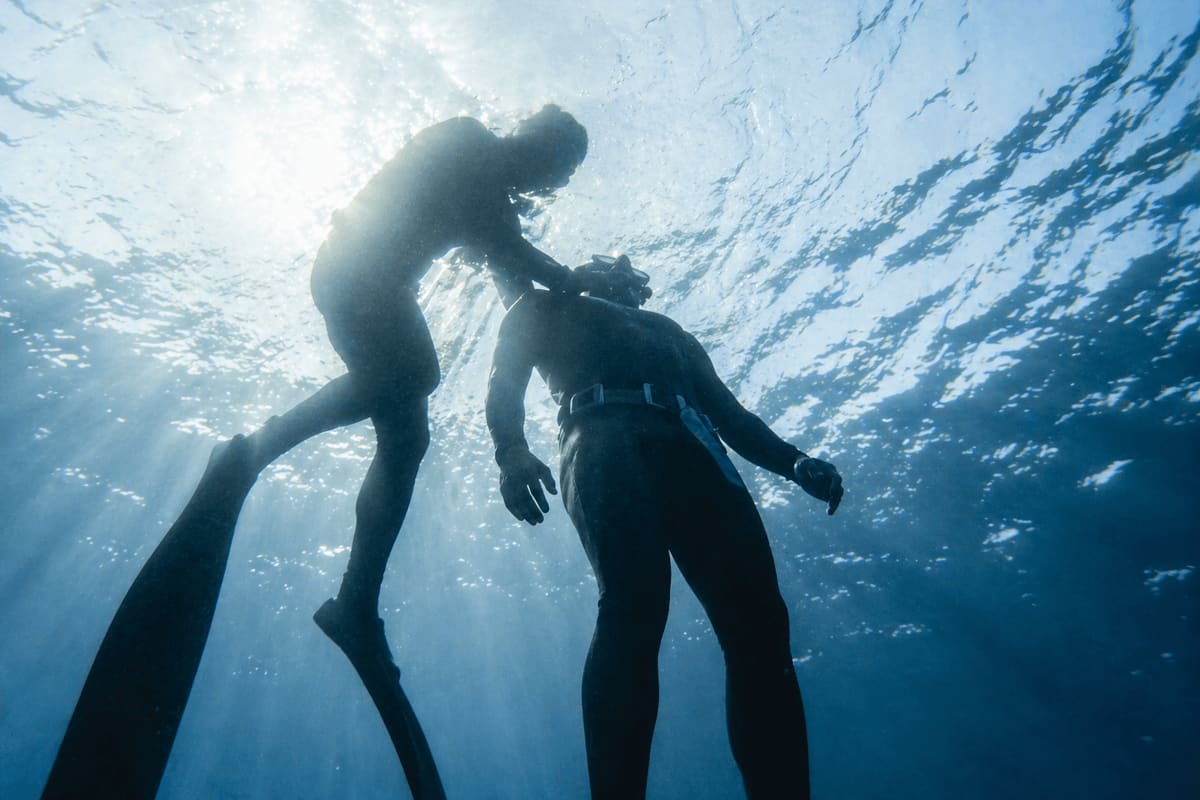
Never freedive alone. Shallow water blackout causes unconsciousness without warning and is only survivable if a trained buddy responds immediately. A buddy who is not watching continuously cannot respond in time.
The Fundamental Rule
The buddy system is the most important safety practice in freediving. Everything else (correct breathwork, technique, controlled depth progression) reduces risk. The buddy system is the mechanism that makes a blackout survivable.
This is not optional or negotiable. Freediving alone, including solo pool training, has produced many fatalities among experienced divers. Rotate: after the diving diver completes recovery breathing and signals OK, roles switch.
The Diving Diver's Responsibilities
- Tell your buddy the plan, target depth and expected dive time before each dive
- Signal before each dive, thumbs-up or OK to confirm readiness
- Signal on surfacing, hand to head (OK signal) and maintain it until buddy returns it
- Complete recovery breathing: exhale first, three full recovery breaths, every time
- Dive within your capacity: the intervention point is at or near the surface, not at the bottom
The Surface Buddy's Responsibilities
- Watch continuously: the entire dive, not periodically
- Know the dive plan: after agreed time passes without surfacing, move toward the line
- Recognize blackout (limp body, no response to calls, face returning to water) act immediately
- Watch through recovery breathing: LMC can occur during this window, not just on descent
- One-up, one-down, never both in the water diving simultaneously
Rescue Protocol
A blacked-out diver presents as: limp body, no voluntary movement, face in the water, unresponsive to calls. Act immediately, do not wait to be sure.
- 01 —Approach and support, get the head above water and face clear
- 02 —Stimulate: firm tap, loud verbal call. Many brief blackouts resolve with stimulation alone
- 03 —If no response: tilt head back, give two rescue breaths (mouth-to-nose or mouth-to-mouth)
- 04 —Call emergency services, if not already done
- 05 —Continue, move toward shore or the boat while maintaining support
Pool Buddy Protocol
Pool training feels safer than open water. It is not.
- Static apnea: the buddy should be in the water at the wall, not on deck
- Dynamic apnea: the buddy follows at the surface, staying directly above the diver
- Brief the lifeguard. They are not trained for freediving rescue; let them know what to watch for
- No shortcuts, 'just a quick session' without a buddy is how pool fatalities happen
Finding a Buddy
If you don't have a regular training partner:
- Beginner courses connect you with other divers at your level
- Local freediving clubs and Facebook groups run pool training sessions
- Freediving centers at popular dive locations often pair divers for training
A buddy doesn't need to be at your depth level. They need to understand the protocol and be reliable about watching continuously.