
Safety First
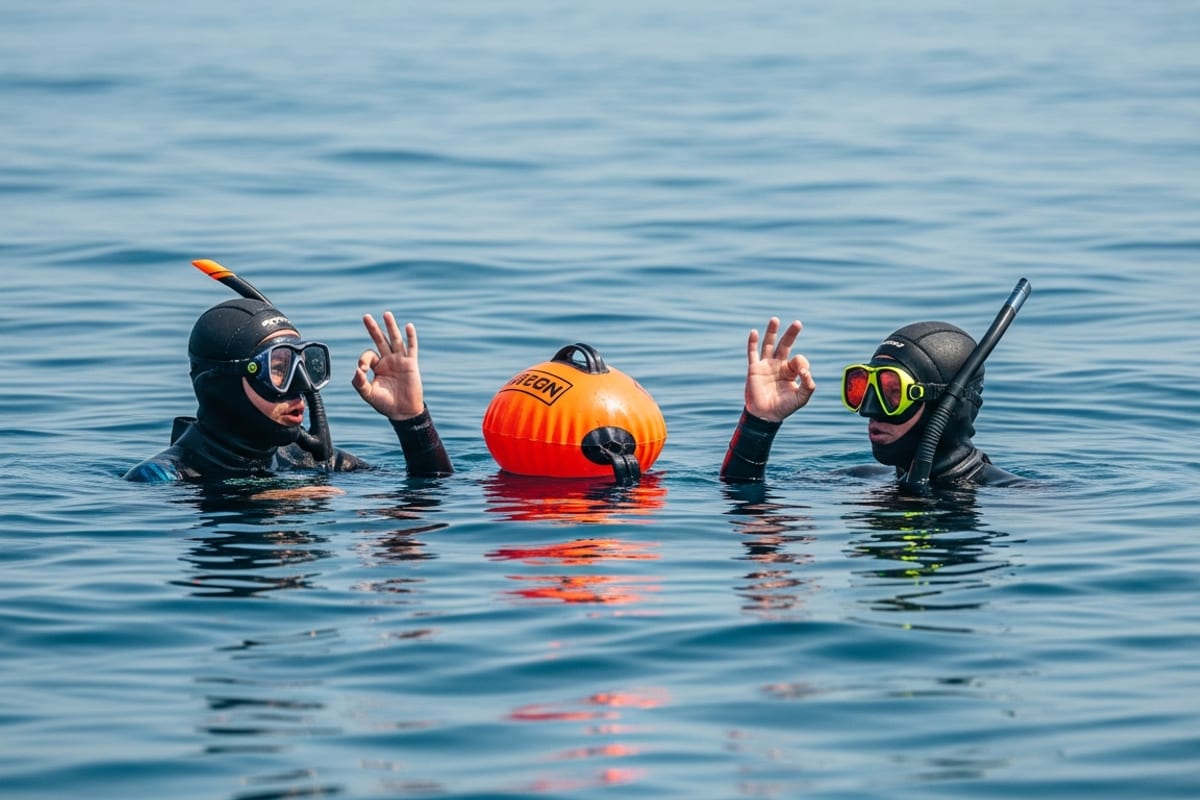
A hand signal without a spoken word is not a complete surface protocol. After every dive the diver removes the mouthpiece, breathes, gives the OK sign, and says the words I am OK. A buddy watches for a full 30 seconds because that is when a blackout or samba is most likely.
Why Signals Matter
Freediving is quiet. You cannot talk underwater, and at the surface a diver recovering from a deep dive is focused on breathing, not conversation. A small, fixed set of hand signals fills that gap. They let a diver confirm readiness, report a problem, and, most importantly, prove they are genuinely conscious and stable after surfacing. Signals are the language of the buddy system, and the buddy system is what turns a shallow water blackout into a survivable event rather than a fatal one.
This guide is about the signals and the communication protocol themselves. If you want the wider picture of who watches whom and how rescue works, read the buddy system guide. Here the focus is narrow: the exact hand shapes, the words that go with them, and the surface routine that decides whether your buddy is safe to leave alone.
The OK Sign And Why Thumbs Up Is Not It
The OK sign is the most used signal in freediving. Touch the tip of your thumb to the tip of your index finger to make a circle, and extend the other three fingers. That single gesture is both a question and an answer. When one diver makes it toward another, it asks are you OK. The other diver returns the exact same sign to answer I am OK. The response has to match. A vague wave or a half-formed shape is not a confirmation.
Question versus response
Context tells you whether an OK sign is a question or an answer. A buddy watching a diver surface gives the OK sign as a query. The surfacing diver, once they have breathed, returns the OK sign as the response. If a diver gives the OK sign and the buddy does not return it, that is a prompt to keep watching, not a reason to relax. The exchange is not complete until both divers have made and seen the sign.
There is one more version for low visibility or night diving. If the buddy cannot see the hand clearly, the OK signal can be made by tapping the top of the head with a flat hand, forming a large circle with the arm over the head. It carries the same meaning: are you OK, or I am OK.
The Surface Protocol: The Most Important Part
Most freediving blackouts and samba episodes do not happen at the bottom. They happen at the surface, in the first several seconds after the dive, when low-oxygen blood returning from the legs and body reaches the brain. This is why the surface protocol exists and why the buddy keeps watching after the head is already up. Skipping this routine is how experienced divers die within arm's reach of help. Read more on how a shallow water blackout and a samba present at the surface.
The four-part sequence
- 01 —Remove the mouthpiece or snorkel. The airway must be clear and the face out of the water. Never surface with a snorkel in your mouth, because a blackout with a snorkel can flood the airway.
- 02 —Take recovery breaths. A short passive exhale, then several controlled recovery or hook breaths to reload oxygen fast.
- 03 —Give the OK hand signal. Make the thumb-and-finger circle and hold it toward your buddy so it is unmistakable.
- 04 —Say the words I am OK out loud while making eye contact. Speaking clearly proves you are conscious, coordinated, and thinking. A diver in trouble cannot form the words.
The 30-second watch window
After the diver surfaces, the buddy watches continuously for at least 30 seconds. Stay within arm's reach. Watch the eyes, the face, and the hands. Do not look at your dive computer, do not turn to talk to someone on the boat, and do not start your own breathe-up. A blackout in this window looks like the eyes rolling, the head dropping, the body going limp, or the face sliding back toward the water. If any of that happens, support the head above water, remove any gear from the face, and follow your rescue training.
This continuous watching, from the moment the diver leaves the surface to well after they return, is the heart of the AIDA and Molchanovs direct-supervision protocol. One diver dives, one buddy watches, and the watch does not end at the surface. It ends 30 seconds later when the diver has proven they are fine.
Start-Of-Dive Signals And The Plan
Good communication starts before the dive, not after it. Every dive begins with a shared plan and a surface interval so the buddy knows what to expect and when to worry. New freedivers should build these habits from their first sessions, which is why the how to freedive guide treats communication as a core skill, not an extra.
The surface interval and countdown
Before a diver goes down, they and the buddy agree on the target depth or time and the maximum they will wait before responding. The diver rests through a surface interval, then runs a final breathe-up. Many teams use a spoken countdown, for example five, four, three, two, one, official top, so both divers share the exact start moment. The buddy notes that moment because it starts the clock. If the agreed dive time passes without the diver surfacing, the buddy moves down the line to meet them.
- Agree the plan: target depth or time, and the maximum wait before the buddy acts.
- Confirm readiness: an OK sign or a spoken ready before the final breaths.
- Mark the top: a countdown to official top so both divers know the start time.
- Buddy tracks the clock: after the agreed time, move to meet the diver, do not wait and hope.
For depth dives the buddy meets the surfacing diver in the last portion of the ascent, usually the final 10 to 15 meters, and rises with them to the surface. This is the zone where blackout risk is highest, so the buddy is already in position when the diver arrives, ready to support them and then run the surface protocol.
Problem, Distress, And Blackout Response
Not every dive goes to plan. A small vocabulary of problem signals lets a diver report trouble early, before it becomes an emergency. Knowing these signals is part of understanding why the sport is manageable rather than reckless, a question covered in is freediving dangerous.
Reporting a problem
- Flat hand rocked side to side: something is wrong or so-so. Not an emergency yet, but pay attention.
- Pointing at a body part: the problem is here. A hand to the ear usually means an equalization issue.
- Thumbs-up: I am ending this and going up. A clear command to abort and ascend.
- Grabbing or tugging the dive line: stop, or I need to hold and sort something out.
Distress at the surface
A diver in genuine distress may wave an arm overhead, slap the water, or fail to return the OK sign at all. Any diver who does not give a clear OK sign and spoken confirmation should be treated as a possible problem. When in doubt, close the distance and ask again.
Responding to a blackout or samba
A blackout is not signaled by the diver, because an unconscious diver cannot signal anything. The buddy recognizes it from the outside: limp body, no response, eyes unfocused or rolled, face returning to the water. A samba, or loss of motor control, looks like shaking, twitching, and jerky movements, and it can slide into a full blackout within seconds. The response is the same for both.
- 01 —Support the head and get the airway clear of the water immediately.
- 02 —Remove any gear from the face: mask, snorkel, or nose clip.
- 03 —Talk and stimulate: a firm tap and a loud call. Many brief blackouts resolve with a blow-tap-talk stimulation and the airway clear.
- 04 —If there is no response, give rescue breaths and follow your trained rescue and emergency-services protocol.
Freediving Signals Reference Table
Use this as a quick reference, but learn the signals in a course and rehearse them with your buddy on land before every session so the meaning is automatic in the water.