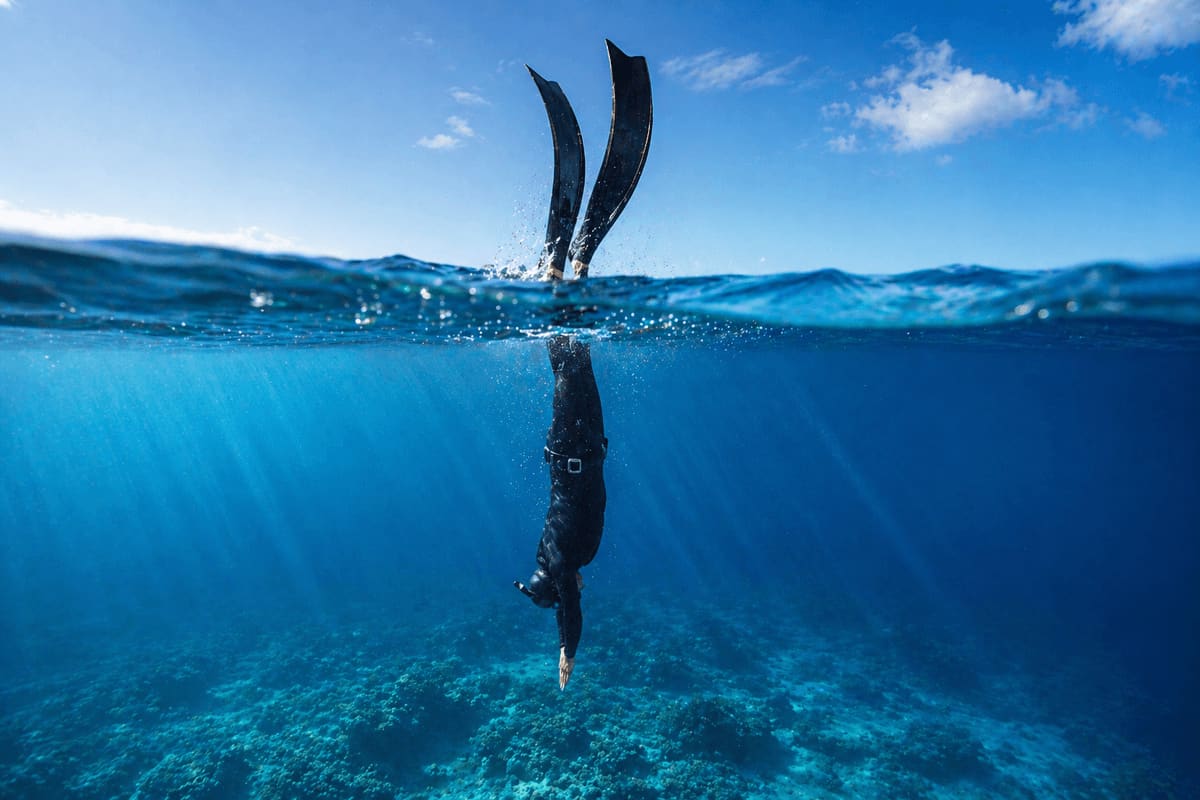

What a Duck Dive Is
The duck dive, also called the pike dive, is the first move in every descent. It is how you transition from lying flat and relaxed at the surface to pointing straight down and dropping into the water. Done well it costs almost no energy and looks effortless. Done badly it wastes oxygen before you have even started to sink. The duck dive is a core part of the wider freediving process, and it is worth drilling until it is automatic.
The physics are simple. Your body is roughly the same density as water at the surface, so you float. To sink you have to change that balance. The duck dive does it by lifting the mass of your legs into the air, where gravity acts on that weight with nothing to support it. That downward force pushes your submerged upper body deeper, and once you pass a few meters the compression of your lungs makes you negatively buoyant, so you keep sinking on your own.
Why the entry matters so much:
- A clean entry gets your head down early, which lets you equalize before pressure builds
- It converts stored height and leg weight into free depth, saving finning energy
- It sets your body alignment for the whole descent, so a crooked entry means a crooked dive
- It keeps you calm, because a smooth silent entry does not trigger the stress a thrashing one does
The Duck Dive Step by Step
Break the movement into five clear stages. Each one flows into the next, but learning them separately makes the whole thing far easier to fix when something goes wrong. Practice this alongside your breathing routine so the final breath and the pike become one connected sequence.
Step 1: The final breath and relaxation
Float face down at the surface, relaxed, breathing calmly through your snorkel. When you are ready, take one final full but relaxed inhale. Do not pack or strain. Drop the snorkel from your mouth as you take that last breath, and let your body stay soft. Tension here follows you all the way down, so the goal is a loose, unhurried breath and a still body before you move.
Step 2: The pike
Bend sharply at the hips so your upper body rotates to point straight down toward the bottom. Reach your arms down and forward at the same time. This is a fold, not a dive forward. Your chest and head go down while your hips stay near the surface acting as the hinge. Keep the movement smooth and deliberate, not a sudden jackknife that slaps the water.
Step 3: Lift the legs vertically
Once your torso points down, raise your straight legs up out of the water until they are vertical, pointing at the sky. This is the part beginners rush or skip. The weight of two legs and a pair of fins in the air is what drives you down. Keep the legs straight and together. The higher and straighter they come out, the more of that weight is unsupported and the deeper you sink for free.
Step 4: The first arm pull or streamline
As you start sinking, take one arm pull, sweeping your arms from overhead down to your sides, to add momentum and set your direction. After that pull, lock into a tight streamline: arms extended overhead or pinned to your sides, head neutral, body in one straight line. A good streamline paired with the right freediving fins makes every bit of that entry momentum count.
Step 5: Start finning only when the fins are underwater
Wait. Your fins have to be fully submerged before your first kick, because fins in the air push nothing but splash and cost you energy for zero return. Once you feel the fins bite water, begin slow, full, relaxed kicks. By this point a clean duck dive has already carried you 2 to 3 meters down, so your first kicks are adding to real momentum rather than fighting to get you moving.
Common Mistakes and How to Fix Them
Almost every duck dive problem comes from rushing or from moving the wrong body part at the wrong time. A quiet, well ordered entry looks slow but travels further than a frantic one. Here are the errors that show up most often on the line and the fix for each.
Lifting the head deserves special attention because it feels natural and ruins everything. When you look forward to see where you are going, your neck extends, your back arches, and your straight streamline turns into a curve that drags. It also strains muscles that should stay relaxed. Trust the line or your alignment and keep your head in line with your spine, chin gently tucked.
Line Dive vs Free Descent
The pike itself is the same whether you dive on a rope or drop into open blue. What changes is what your hands and eyes do after the entry. Understanding the difference helps you choose the right entry for the discipline you are training, and it matters across the range of freediving disciplines.
- Line dive entry
- You pike right next to the dive line. After the first pull you either glide beside the rope or use it to guide and, in some disciplines, to pull yourself down. The line gives a fixed reference for depth and direction, so your only job is a clean vertical entry close to the rope without grabbing it in a way that yanks you off line.
- Free descent
- With no rope to reference, your streamline and first arm pull set your entire direction. A crooked pike sends you diving at an angle, wasting depth and drifting off your intended path. Body alignment is even more important here because nothing corrects your course for you.
For a new diver, learning on a line first is the sensible path. The rope removes the guesswork about depth and direction and lets you focus entirely on the mechanics of the pike, the leg lift, and early equalization. Once the entry is automatic, transferring it to a free descent is mostly a matter of trusting your alignment without a visual reference.
Setting Up Early Equalization
The single biggest reason to master the duck dive is that it makes early equalization possible. Because the pike points your head straight down and starts a smooth descent, you can equalize the moment you submerge, before pressure has a chance to build against your eardrums. This connection between entry and equalizing is covered in depth in the equalization guide, and it is worth reading alongside this one.
The rule is to equalize before you feel pressure, not in response to it. On a head-down descent that means your hand should be moving toward your nose almost as your face goes under. A messy duck dive works against this. If you enter at an angle, or lift your head, or thrash to get moving, you delay the point at which you can comfortably equalize, and by the time you settle into the descent you are already behind on your ears.
A low volume mask helps here too, because a low volume freediving mask holds less air to equalize and sits closer to your face, so it needs less effort to keep balanced as you drop. Small gear choices like this reduce the number of things competing for your attention during those critical first meters.
Drills and Streamlining
The duck dive is a motor skill, which means it improves with focused repetition, not with force. A few minutes of deliberate entries at the start of each session builds the movement far faster than grinding out deep dives with a broken pike. Treat these drills the way you treat any technique work, with full rest between reps and honest attention to what your body is doing.
Practice drills:
- 01 —Shallow pike reps: in water just deep enough to submerge, practice only the pike and leg lift with no finning. Aim for silence and a fully vertical leg lift before you touch bottom.
- 02 —One-pull glide: duck dive and take a single arm pull, then hold streamline and count how far you glide before you need to fin. Try to extend the glide each session.
- 03 —No-splash challenge: have a buddy watch or listen and tell you honestly whether the entry was silent. Fix the loudest fault first, then repeat.
- 04 —Slow-motion pike: perform the whole sequence at half speed on land or in shallow water to feel the correct order of hips, legs, arms, then fins.
- 05 —Equalize-on-entry drill: on every practice dive, make your first equalization the instant your head submerges, so early equalizing becomes automatic.
Streamlining checklist:
- Legs straight and together, no bent knees
- Arms extended overhead or pinned tight to the sides, not flapping
- Head neutral, chin lightly tucked, eyes down not forward
- Back flat, no arch, body in one straight line from fingertips to fin tips
- Fins fully submerged before the first kick
- Whole body relaxed, no clenched shoulders or gripped jaw
Combine these drills with your wider training and they compound quickly. A diver who spends ten focused minutes on entries each session will out-descend one who only chases depth, because the clean entry saves oxygen and buys equalizing time on every single dive. For structured practice, fold duck dive work into your regular breathing and relaxation training so the calm you build on the surface carries into the pike.