
Pool Disciplines
Freediving has six primary competition disciplines, each testing a different aspect of breath-hold performance. Most recreational freedivers work across two or three of them without ever formally competing, but understanding the structure helps you train with purpose. The current freediving world records show where the limits sit in each one.
Static Apnea (STA)
- What it is
- floating face-down in a pool, holding your breath as long as possible: no movement, no depth, pure duration
- How it's measured
- time
- World record
- 24+ minutes (with pre-dive oxygen breathing)
- Why it matters
- the most isolated form of breath-hold practice, builds CO2 tolerance and breath-hold duration that feeds all other disciplines
- When to train it
- every pool session, 3-5 near-maximum holds with full recovery
Dynamic Apnea with Fins (DYN)
- What it is
- horizontal underwater swimming on one breath, with fins: push from the wall, swim as far as possible, surface
- How it's measured
- distance in meters
- World record
- 300m (approximately 12 pool lengths)
- Why it matters
- develops breath-hold endurance under physical load, kick efficiency, and body streamlining, the primary pool training discipline for most freedivers
Dynamic Apnea Without Fins (DNF)
- What it is
- same as DYN but using only body undulation and arm strokes, no fins
- World record
- 244m
- Why it matters
- more technically demanding than DYN, trains body position and undulation that carries over to cleaner CWT and better DYN distances
Open Water Disciplines
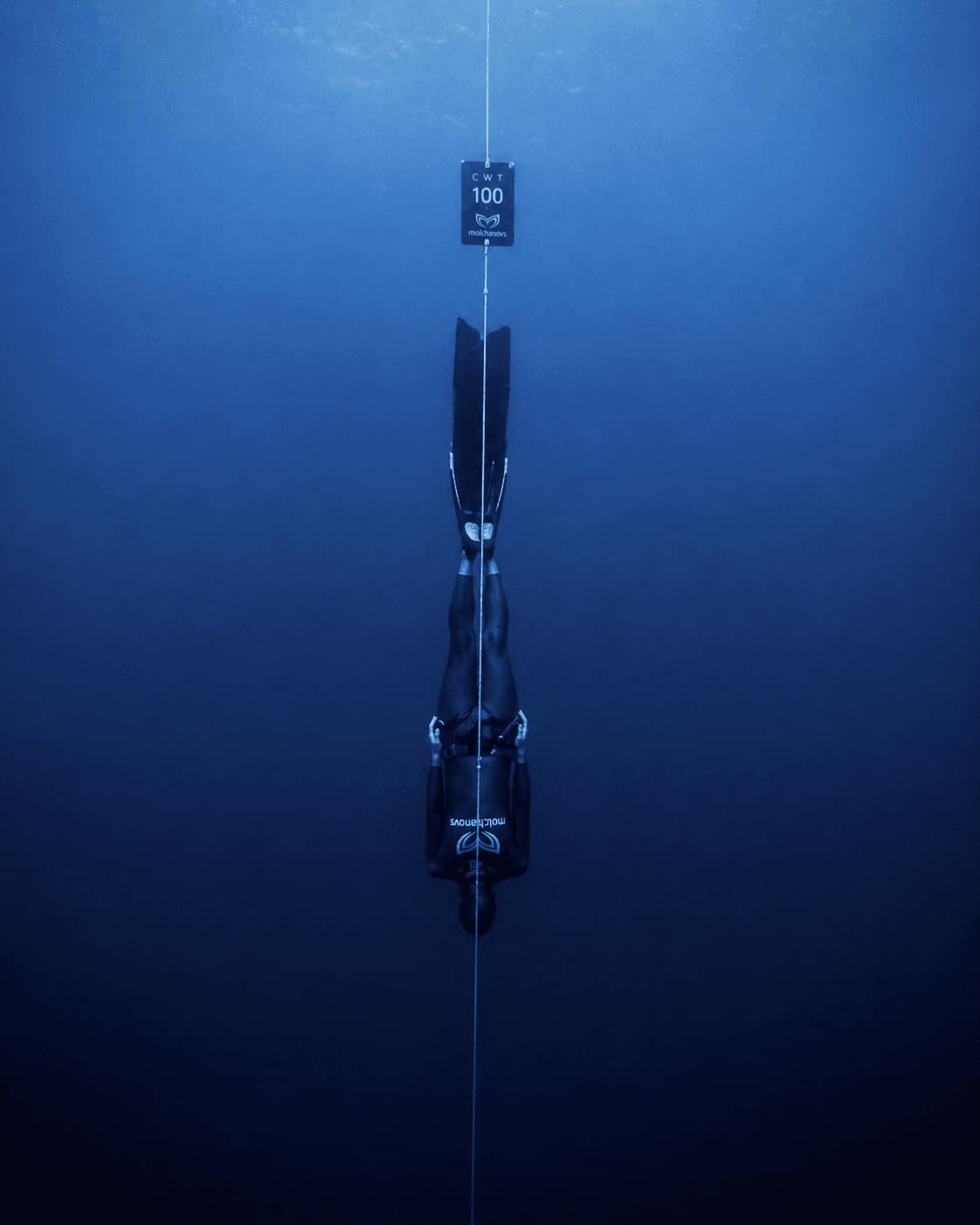
Constant Weight with Fins (CWT)
- What it is
- vertical depth diving with fins and weight belt, descending and ascending under your own power, no touching or pulling on the dive line
- How it's measured
- maximum depth in meters
- World record
- 131m (men), 114m (women)
- Why it matters
- what most people mean when they say 'freediving': the discipline most directly connected to recreational diving, spearfishing, and underwater exploration
Constant Weight Without Fins (CNF)
- What it is
- same as CWT but with no fins, only dolphin kick with bare feet and hands
- World record
- 102m (men, William Trubridge), 73m (women)
- Why it matters
- the most technically demanding depth discipline: excellent for developing body position, relaxation, and technique quality that transfers to better CWT
Free Immersion (FIM)
- What it is
- pulling yourself down and up a dive line hand-over-hand, without fins
- World record
- 122m (men), 98m (women)
- Why it matters
- removes kick technique from the depth equation, ideal for practicing equalization at progressive depths
- When to train it
- during equalization progression, excellent for warming up CWT sessions
No Limits (NLT), Historical
Historically allowed any means of descent (weighted sled) and ascent (inflatable bag). No longer in active AIDA competition after Herbert Nitsch's 253m attempt in 2012, which resulted in a serious decompression accident.
How the Disciplines Connect
They're not siloed. They build on each other:
A typical training week for serious freedivers
- 2× pool sessions (STA + DYN focus)
- 1× open water FIM or equalization focus
- 1× open water CWT depth progression
You don't need to compete to use the discipline framework. Training across STA, DYN, and CWT with clear metrics (hold times, distance, depth) gives training direction and makes progress measurable.