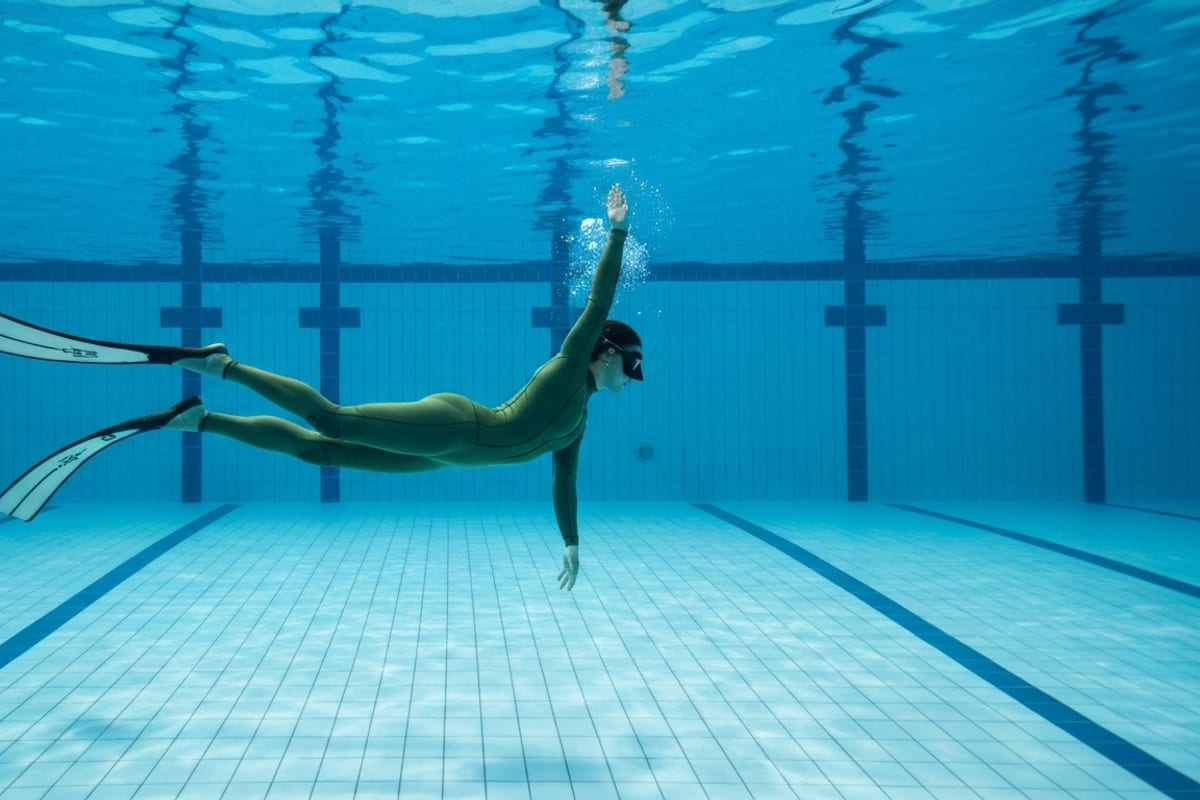

What Dynamic Apnea Is
Dynamic apnea is the pool discipline where you swim as far as you can, horizontally and fully underwater, on one breath. It is one of the core competitive events in freediving, and unlike depth diving it needs nothing more than a pool, a buddy, and a length to swim. If you are new to breath-hold sports, it pairs naturally with static apnea, which builds the mental side of the breath-hold, and with general pool training, which builds the aerobic base underneath it.
There are two dynamic disciplines, split by whether you wear fins. DYN, dynamic with fins, is done with either a monofin or bifins and produces the longest distances of any freediving event. DNF, dynamic no fins, uses a modified breaststroke and no equipment on the feet, so it is slower, shorter, and far less forgiving of wasted movement. Both are recognized by AIDA and CMAS, the two main freediving federations, and both are scored purely on distance in meters. For a wider map of the sport, see the full freediving disciplines overview.
The reason distances get so long is simple physics. There is no depth, so there is no pressure crushing your lungs, no equalization to worry about, and no long ascent burning oxygen. Everything you have goes into forward motion and staying calm. That also means the sport rewards efficiency above all else. The diver who wins is rarely the strongest swimmer. It is the one who moves the least water for the most distance.
Technique: Streamline, Kick, Glide
Good dynamic apnea is three things repeated over and over: a tight streamline, an economical kick, and a long glide. Drag is your real opponent, and it rises with the square of your speed, so swimming fast is a trap. Slow, smooth, and clean beats fast and thrashy every single lap.
Streamline
Your body should form the narrowest possible profile through the water. Arms extended overhead, one hand over the other, biceps squeezing the ears, head in a neutral position looking down and slightly forward. Hips up near the surface, not sinking. Any bend at the neck or a lifted head acts like a parachute. Freedivers spend more time fixing streamline than any other single element, because a poor line quietly steals meters on every lap.
The kick cycle in DYN
With a monofin, propulsion comes from a full body undulation that starts at the hips and rolls down through the legs into the fin, like a dolphin. The upper body stays quiet. With bifins you use a slow, wide flutter kick driven from the hips, not the knees, with pointed toes and relaxed ankles. In both cases the kick should be unhurried and rhythmic, with a distinct rest phase. A monofin is the most efficient tool for distance, and if you are choosing one, the best monofin guide covers stiffness and fit. Beginners often overkick, spiking their heart rate and burning oxygen. Aim for one relaxed kick, then a pause.
The glide
Between kicks you hold the streamline and let the water carry you. In DNF this is even more pronounced: you pull, kick, then glide in a full arrow position for two to three seconds before the next stroke. The glide is where the discipline is won, because it costs almost no oxygen and covers real distance. New divers cut the glide short out of nervousness. Learning to trust it, to wait in that quiet stretched out moment, is a large part of the skill.
The Turn at the Wall
In a standard 25 meter or 50 meter pool, the turn is where distance is made or lost. A clumsy turn scrubs off all your glide speed and forces a hard restart, which spikes oxygen use right when you can least afford it. A clean turn keeps momentum and lets you carry speed into the next lap for free.
- 01 —Approach the wall still streamlined, not sprinting into it. Let the glide bring you in.
- 02 —Tuck into a compact roll or flip, keeping the movement small and tight rather than a big showy somersault.
- 03 —Plant both feet flat on the wall, knees loaded, body already turning to face the new direction.
- 04 —Push off smoothly into a full streamline, one hand over the other, and hold that line before you resume kicking.
- 05 —Delay the first kick a beat, riding the push-off glide as far as it will carry you.
The push-off is legal propulsion, so use it fully, but do not over-power it. A violent shove wastes energy and throws you off your line. Practice turns slowly and in isolation until the sequence is automatic, because under low oxygen your coordination degrades and you want the turn already burned into muscle memory.
Training a Distance Progression
You build dynamic distance the same way you build any endurance skill: gradually, with structure, and with far more attention to technique than to hitting a number. Chasing a personal best every session is the fastest route to a plateau and a scare. Most of your training should sit well inside your comfortable range.
A common tool is a distance ladder, where you swim repeated laps with fixed rest, holding technique together as fatigue builds. For example, swim a comfortable distance you can cover without strain, rest, repeat, and only extend once the current distance feels genuinely easy and clean. This is a form of interval training rather than a maximal effort, and it is where most real gains come from.
- Technique laps
- Short, easy swims at low effort where the only goal is a perfect streamline, kick, and turn. The backbone of every session.
- Distance intervals
- Repeated moderate swims with fixed rest to build endurance and CO2 tolerance without going near your limit.
- Occasional max attempts
- Rare, well rested, fully supervised swims to test progress. No more than one per session, and not every session.
Rough milestones help you set expectations. Many people reach 25 meters within a handful of sessions once they relax. Fifty meters is a realistic few-month goal, and 75 to 100 meters is achievable for a committed recreational freediver. Beyond that, progress slows and depends heavily on relaxation, CO2 tolerance, and flawless mechanics rather than fitness alone.
CO2 Tolerance Under Movement
The urge to breathe you feel underwater is driven mostly by rising carbon dioxide, not by falling oxygen. In dynamic apnea that urge arrives faster than in a motionless hold, because your working muscles are producing CO2 the whole time. This is why a strong static breath-hold does not automatically translate into long distance. You have to train your tolerance to CO2 while your body is actually moving.
The main tool for this is CO2 tables, structured sets where you take progressively shorter recovery breaths between holds so CO2 accumulates. Done dry, on land, they build tolerance safely with no drowning risk. The full method is laid out in the CO2 tables guide, and it pairs well with in-water dynamic sets once the dry work is solid.
- Train CO2 tolerance dry first, on land, where a blackout carries no water risk.
- Never hyperventilate before a dive. Blowing off CO2 removes your warning signal and makes blackout far more likely.
- Learn the difference between the early urge to breathe and true contractions, so you know where you are in a swim.
- Keep effort low, since harder swimming produces more CO2 and shortens your comfortable range.
As tolerance improves, the early contractions stop feeling like an emergency and become just a signpost telling you how far into the swim you are. That calm relationship with the urge to breathe is what lets experienced freedivers relax through distances that would panic a beginner.
Records and Blackout Safety
The top of the sport shows what streamlining and glide can achieve. In DYN with a monofin, Alexey Molchanov has pushed the men's world record beyond 300 meters, an astonishing distance on a single breath. In DNF, no fins, the men's record sits above 240 meters, with athletes such as Mateusz Malina among those to have reached that range. On the women's side, Magdalena Solich-Talanda has set DYN records over 250 meters. These figures move as the sport progresses, but they show the ceiling that near perfect technique makes possible.
Records aside, the single most important thing to understand about dynamic apnea is where blackout happens. It almost always strikes at the very end of a swim, on the last few meters or right at the surface, when oxygen is at its lowest. This end-of-lap timing is why safety is non-negotiable and why the finish deserves the most attention.
- One up, one down
- Every attempt needs a trained safety diver watching, ready to bring you up. Never train dynamic alone, ever.
- Watch the finish
- The safety diver focuses hardest on the final meters and the surface, because that is where blackout lands.
- Surface protocol
- On surfacing, the diver performs a breathing recovery and a clear signal within a set time to prove they are conscious and fine.
- No hyperventilation
- Never over-breathe before a dive. It delays the urge to breathe and hides how close you are to blacking out.
Blackout in a pool is fully survivable when a buddy is present and gets your airway out of the water immediately. It becomes deadly only when someone is alone or unwatched. The related risk of shallow water blackout is worth reading in full, because the same low-oxygen mechanism applies whether you are moving horizontally in a pool or ascending from depth.