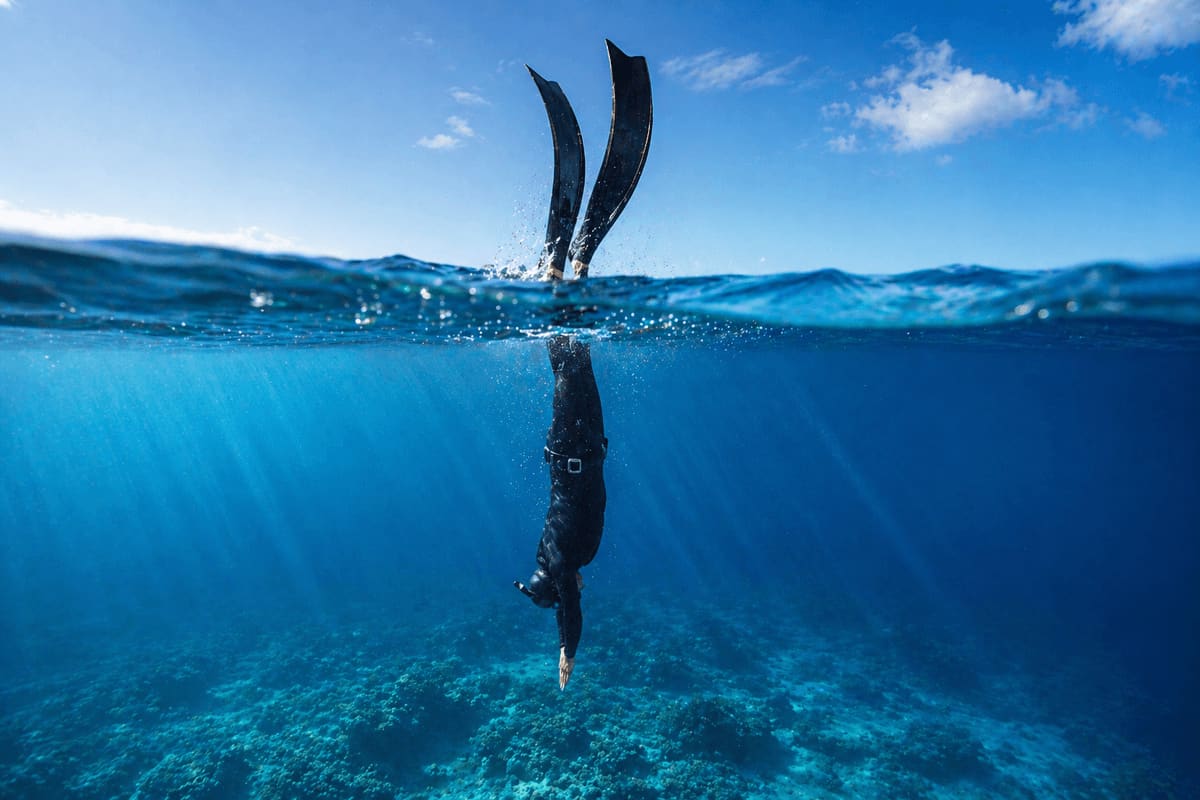

The One Principle That Matters Most
Almost every piece of freediving nutrition advice comes back to a single idea: dive on a light stomach. Not starving, not full. Light. Everything else in this article is detail hung off that one rule, and if you only remember one thing, remember that a heavy meal and a good dive do not belong in the same afternoon.
There are two reasons for it. The first is blood flow. Digestion is an active process that pulls blood toward the gut, and freediving depends on the opposite pattern: blood shifting toward the core and the brain as part of the mammalian dive reflex. You do not want your body running a big digestive job while you are asking it to conserve oxygen and slow your heart rate.
The second reason is mechanical, and it is the one you feel immediately. A full stomach presses up against the diaphragm and limits how far it can travel. That makes a full, relaxed inhale uncomfortable, it makes the breathing techniques you use before a dive feel cramped, and at depth it can make the whole experience tense. Divers often describe a heavy meal as a feeling of not being able to get a proper breath in.
Freediving nutrition also gets far more attention than it deserves. Food will not add metres to your dive. Technique, relaxation and consistent breath hold training will. What food can do is remove obstacles: stop you feeling bloated, keep your energy steady across a three hour session, and help you recover well enough to train again the next day.
How Long Before A Dive To Eat
Timing matters more than the exact contents of the plate. The general rule most freediving instructors teach is a light snack 1-2 hours before diving, and a full meal 3-4 hours before. Those numbers are guidelines rather than physiology set in stone, because stomach emptying varies a lot between people and between meals.
Fat and large volumes slow stomach emptying the most, so a greasy meal sits longer than the same calories from rice and fruit. Protein sits somewhere in between. Simple carbohydrates clear fastest, which is why the classic freediver breakfast is something bland and carbohydrate based rather than a full cooked plate.
For pool sessions the rules can relax slightly. Depth changes and squeeze pressure are not part of pool training, so a mildly full stomach is less of a problem there than it is on a deep line. It still affects your inhale, so do not treat the pool as an excuse for a big lunch.
What To Eat Before A Session
The pre-dive meal has one job: give you steady energy without sitting heavy. That points toward easily digested carbohydrates, a modest amount of protein, and very little fat or fibre. This is not the meal for your high fibre health kick, because fibre is exactly what keeps food and gas moving slowly through the gut.
Good pre-dive foods
Gas is the underrated problem on that list. Beans, brassicas, sugar alcohols in diet bars and fizzy drinks all leave gas in the gut, and gas is a volume that changes with pressure. On a shallow dive it is a nuisance. On a deeper dive it is an unpleasant distraction at exactly the moment you should be relaxed and focused on your freediving technique.
- Morning session
- Small carbohydrate breakfast at least 1.5 hours out, or dive fasted if the session is short and you handle it well.
- Afternoon session
- Normal breakfast, light lunch 3 hours out, small snack 1 hour out if you feel low.
- Evening session
- Keep lunch normal, skip the big afternoon snack, eat properly after you get out.
- Travel and boat days
- Pack your own food. Boat catering is usually the wrong kind of meal at the wrong time.
The Dairy Question, Honestly
Ask around any freediving course and someone will tell you to cut dairy before diving because it produces mucus and ruins equalisation. It is one of the most repeated pieces of advice in the sport. It is also one of the weakest supported.
The research on milk and mucus is fairly consistent in a boring direction: studies looking at milk intake and nasal or airway congestion have generally not found that dairy increases mucus production. What does seem to happen is a change in the perceived texture of saliva and mucus in the mouth after drinking milk, which feels like more mucus without actually being more mucus. That is a real sensation, but it is not the same claim.
The practical position: if you feel congested after dairy, drop it before diving. Congestion of any kind makes equalisation harder and forcing an equalisation through a blocked ear is how people get barotrauma. But do not treat dairy avoidance as a performance technique, and do not assume cutting cheese will fix an equalisation problem that is really about technique or a cold.
What Works Against You
Some things are worth avoiding for reasons stronger than tradition. These are the ones with a clear mechanism behind them.
- Heavy fats
- Slow stomach emptying more than any other macronutrient. A fatty meal can still be sitting there four hours later.
- Very large protein meals
- Also slow to clear, and they tend to come with a lot of volume. Fine at dinner, poor choice at midday before a session.
- Carbonated drinks
- Add gas directly to the stomach. Gas plus pressure changes plus a restricted diaphragm is a bad combination.
- Alcohol the night before
- Disrupts sleep quality, promotes fluid loss, and leaves you starting the session already behind on hydration and recovery.
- Excess caffeine
- Raises heart rate and can increase a jittery, alert feeling that fights the relaxation you are trying to build.
- Anything new on a big day
- Competition day or a personal best attempt is the wrong time to try an unfamiliar food, gel or supplement.
Caffeine deserves a nuance. It is not banned. Plenty of divers have their normal morning coffee and dive perfectly well, and abruptly quitting caffeine on the morning of a session can cause a headache that ruins the day. The problem is dose. A large pre-workout style hit before a static apnea attempt works directly against the calm, low heart rate state you are trying to reach. Keep it to your usual amount, and if you are chasing a relaxed static, consider having it earlier.
Understanding shallow water blackout and diving with a competent buddy matters infinitely more than whether you had toast or oats.
Hydration Matters More Than You Think
Hydration is the part of freediving nutrition most divers underestimate, partly because you do not feel thirsty in cold water and partly because you cannot see yourself sweating inside a wetsuit.
Add sweating inside a wetsuit while you kit up on a hot boat deck, plus dry air on the way to the site, and it is easy to finish a session meaningfully down on fluid. The consequences show up as headaches, cramping, a groggy feeling between dives and slower recovery afterwards.
- Drink steadily through the morning rather than forcing large volumes right before you dive
- Aim for pale yellow urine before the session as a rough check
- Add electrolytes for long sessions, hot conditions, or if you sweat heavily
- Sip warm drinks between dives in cold water, since staying warm helps you stay relaxed
- Do not overdrink in the last 30 minutes, because a sloshing stomach is its own problem
There is a balance to strike. Being overhydrated right before a dive means a full bladder and the constant urge to pee, which is a poor state for relaxation. Steady intake across the whole day beats a panicked litre at the last moment.
Eating During A Long Session
A long day in the water, a four hour depth session or a full day of a course, creates a problem the simple rules do not cover. You cannot eat a proper meal because you are still diving, but running on fumes by hour three makes you cold, sloppy and less attentive as a buddy.
The answer is small and frequent. Small carbohydrate snacks between dives keep blood sugar and warmth steady without loading your stomach. This is where dates, bananas, dried fruit and small bars earn their reputation as standard freediver boat food.
- 01 —Take a small snack after a set of dives, not right before one
- 02 —Give any real food at least 45-60 minutes before your next deep dive
- 03 —Pair the snack with fluid, since both are being depleted together
- 04 —Keep portions genuinely small, at roughly a few bites rather than a meal
- 05 —Stop snacking entirely if you have a max attempt planned within the hour
Cold is the hidden factor here. Being cold burns energy fast and makes relaxation much harder, and an underfuelled diver gets cold quicker. If you find yourself shivering between dives, the answer is often a warm drink, a snack and a dry layer rather than pushing on into another attempt.
Eating After Diving
Post-dive eating is much simpler, because the constraints disappear as soon as you are out of the water. Once you have completed your recovery breathing, changed into dry clothes and confirmed everyone is fine, you can eat normally.
A sensible recovery meal covers three things: carbohydrate to refill what you used, protein to support the training load, and fluid plus salt to replace what you lost. That can be as ordinary as rice with fish and vegetables, or a sandwich and a large glass of water. There is no need to complicate it.
- Rehydrate first, before you worry about food composition
- Eat within an hour or two if the session was long or hard
- Include some salt, especially after a hot day or heavy sweating
- Warm food helps if you are still cold from the water
- Sleep is the recovery tool that outperforms every nutrition strategy
"The best recovery meal is the one you actually eat, not the one you planned and skipped because you were tired."
If You Train Several Times A Week
Divers training regularly, several pool sessions plus dry work each week, have a slightly different problem. Individual meal timing matters less than the overall quality of the diet across the week.
Iron and oxygen carrying
Iron is genuinely relevant to freedivers because it is a component of haemoglobin, the protein that carries oxygen in blood. Low iron means less oxygen carrying capacity, which shows up as fatigue and poor tolerance during hard apnea training long before it shows up as anything dramatic. This does not mean iron supplements make you a better diver. It means being deficient makes you a worse one, and that is a different claim.
- Red meat, liver and shellfish are the most readily absorbed sources
- Lentils, beans, tofu and dark leafy greens are useful plant sources
- Vitamin C alongside plant iron sources helps absorption
- Tea and coffee with meals reduce iron absorption, so shift them between meals
- Menstruating divers and vegetarian divers are at higher risk of low iron
Anti-inflammatory eating
Frequent training creates a recovery load, and a diet built around oily fish, vegetables, fruit, olive oil, nuts and whole grains supports recovery better than one built around fried food and sugar. That is not a freediving-specific claim, and no single food is anti-inflammatory in a way that changes your dive. It just means the boring general advice happens to also be the right advice for divers.
Supplements: A Sceptical Look
The supplement industry loves endurance and performance niches, and freediving attracts its share of products promising longer breath holds. Approach the whole category with your scepticism switched on.
The honest summary is that most divers get nothing meaningful from supplements beyond correcting an actual deficiency. Money spent on coaching, a better wetsuit or more time in the water buys far more performance than anything in a tub. Supplements are also poorly regulated in many countries, so quality and contamination are real considerations for anyone competing.
Leaner Is Not Automatically Better
There is a persistent idea that dropping body fat improves depth performance, and it deserves pushback. Body composition affects freediving in more than one direction, and the trade-offs are not all in favour of being lean.
- Buoyancy
- Fat is less dense than muscle, so leaner divers tend to be less buoyant at the surface. That means an easier descent but a harder, more effortful final stretch of the ascent and a less comfortable rest at the surface.
- Thermal protection
- Body fat provides insulation. Lean divers get cold faster in the same water and wetsuit, and being cold is one of the fastest ways to lose relaxation.
- Energy availability
- Under eating to stay lean means worse recovery, worse sleep, worse mood and less consistent training. That costs more than a small change in body composition gains.
- Lung and chest flexibility
- Flexibility work matters far more here than body fat percentage. There is no shortcut in which being thinner substitutes for training.
Look at competitive freedivers and you will not find a single body type. Being fit and well fuelled matters. Being extremely lean does not appear to be a requirement, and pursuing it aggressively pushes some athletes into under eating, which is a genuine health risk rather than a performance strategy.
A Sample Day Around Afternoon Training
Here is what a straightforward eating day might look like for a diver with a pool or line session starting at 4pm. Adjust the times, not the shape.
Notice what is not in there: no special powders, no elaborate protocol, nothing exotic. It is ordinary food arranged sensibly around a session. The only real decisions are the size of lunch and how far ahead of the session it lands.
Try it, note how you feel in the water, then adjust. Some divers need that 15:00 snack every time, others feel best going into the water with nothing since lunch. The only way to find out is to keep a rough note of what you ate alongside how your session went, in the same way you would track your pool training numbers.
Takeaways
- Dive on a light stomach: a snack 1-2 hours out, a full meal 3-4 hours out
- Favour simple carbohydrates and low fat, low fibre food before a session
- Skip carbonated drinks, heavy fats, big protein loads and alcohol the night before
- Dairy is a personal test, not a rule, because the mucus evidence is weak
- Hydrate steadily all day, since immersion increases fluid loss without thirst
- Snack small between dives on long sessions and eat properly afterwards
- Test for deficiencies rather than guessing at supplements
- Extreme leanness is not a performance advantage in freediving
Food removes obstacles, it does not create performance. Get the timing right, stay hydrated, eat like a reasonable adult the rest of the week, and put the saved energy into technique and relaxation work instead. Anyone with a medical condition, a specific dietary requirement, or a history of disordered eating should talk to a doctor or dietitian before making changes based on general advice like this.