
Why Thailand is the easiest place to start freediving
Thailand has quietly become the world's busiest entry point into freediving, and it comes down to one island. Koh Tao, a small granite dot in the Gulf of Thailand, has the highest concentration of freediving schools anywhere. A dozen of them compete inside a few square kilometers, which drives course prices down to the lowest you will find at any established hub. A beginner certification here costs less than dinner and a hotel night in most European dive towns. If you are still deciding what freediving even involves, start with what is freediving and come back.
The conditions help too. Surface water holds at 28-30°C for most of the year, so you train in a rashguard or a thin 1.5mm suit instead of fighting cold the way you would in the Mediterranean off-season. The sheltered bays are calm, the schools are stacked with AIDA, SSI, PADI, and Molchanovs instructors, and a deep granite pinnacle a short boat ride out gives you a clean training line in good visibility. For a comparison of how Thailand stacks up against other warm-water beginner spots, our guide to freediving in Bali covers the closest competitor.
Koh Tao, the freediving capital of the Gulf
Koh Tao is the reason Thailand shows up on freediving maps. It is small, walkable in parts, packed with cheap accommodation, and built around water sports. The freediving scene grew out of the much older scuba industry here, and the result is a tight cluster of schools teaching every major agency. You can land on the island, book a course the same afternoon, and be doing line work the next morning.
Training bays and the open-water line
Most schools split a course between two environments. Confined-water skills, rescues, recovery breathing, and static work, happen in the calm shallow bays on the west and north coasts where the water is flat and clear. Sairee, Mango Bay, and Tanote Bay are the usual choices, all sheltered and beginner-friendly. Depth work happens from a boat over a dedicated freediving line, usually anchored over deeper water close to shore so the surface stays calm.
Chumphon Pinnacle and the deeper sites
Koh Tao's signature dive site is Chumphon Pinnacle, a granite tower that starts around 14m and drops past 35m, with visibility that regularly tops 20m. It is primarily a scuba site for the big pelagics that gather there, but it shows the kind of clear, deep water that makes the area good for depth progression. Sail Rock, halfway to Koh Phangan, breaks the surface and drops to around 35m with a famous vertical chimney swim-through. Most freediving line sessions happen closer to home over purpose-set lines rather than at these scuba pinnacles, but they explain why the water here suits the sport.
- Water temp
- 28-30°C most of the year, around 27°C in December and January. Rashguard or 1.5-2mm suit.
- Visibility
- 20-30m at its best (February to April). Drops to 5-20m during the monsoon runoff.
- Best season
- March to September for the Gulf. Diveable most of the year thanks to the island's sheltered position.
- Beginner depth
- Course lines typically set to 10-20m for AIDA 2 / SSI Level 1, deeper for intermediate levels.
- Beginner cost
- 8,000-11,000 THB (about $230-310 USD), gear usually included.
The Andaman side, Phi Phi and Koh Lanta
Thailand has two coasts on opposite weather schedules, which is the country's secret weapon. While the Gulf side around Koh Tao runs from March to September, the Andaman side, Phuket, Koh Phi Phi, and Koh Lanta, is at its best from November to April. If your travel dates fall in the Gulf's wet season, you simply cross to the other coast. For the wider picture of finding a school wherever you land, see freediving near me.
Koh Phi Phi
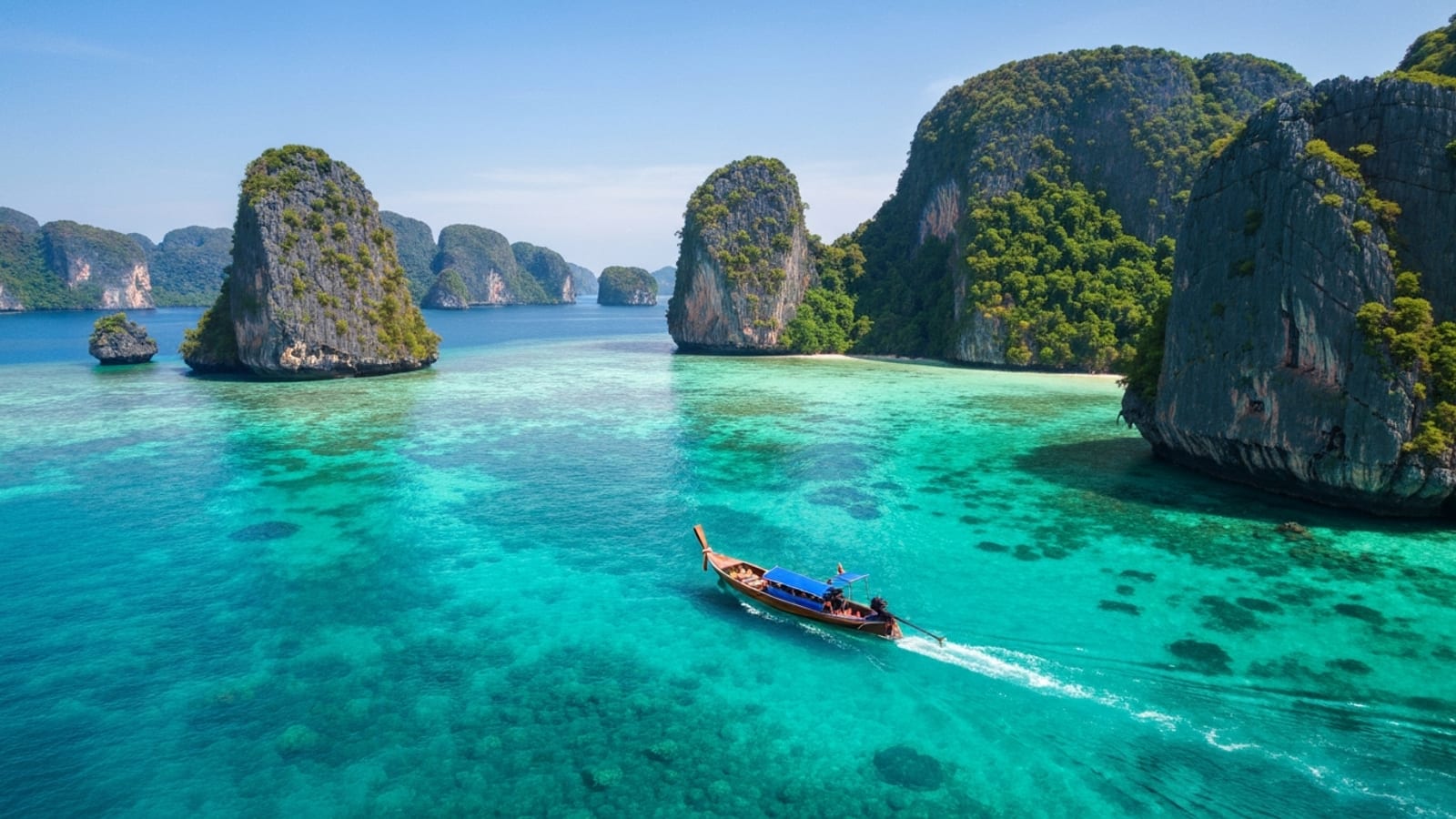
Phi Phi is the dramatic one, limestone karsts rising straight out of turquoise water. The freediving scene is smaller than Koh Tao's but real, with a handful of schools running beginner courses and fun sessions around the islands. Water clarity around the outer sites is excellent in the November-to-April window. The trade-off is crowds and higher prices than Koh Tao, since Phi Phi is a major tourist destination first and a training hub second.
Koh Lanta
Koh Lanta is quieter and more relaxed than Phi Phi, a better base if you want to train without the party scene. It sits within reach of strong Andaman dive sites and has a small, serious freediving presence. Several operators run AIDA and SSI courses, and the calmer pace suits divers who want to focus. Like Phi Phi, it shines in the dry season from November to April.
Freediving courses and what they cost
Thailand teaches every major freediving certification. AIDA and SSI are the most common, with Molchanovs growing fast and PADI Freediver offered at the larger scuba schools. The certifications are identical to what you would earn anywhere else in the world, but the price is the lowest at any established hub. Most beginner courses run two to three days and include theory, confined-water skills, and open-water line dives.
If you are weighing one agency against another before you book, our breakdown of the best freediving certification explains how AIDA, SSI, and Molchanovs differ in practice. For Thailand specifically, pick the school first and the agency second, since the teaching quality matters far more than the logo on the card.
When to go, by coast
For a Koh Tao-focused trip, February to April is the strongest window, calm seas, the best visibility of the year, and warm water. If you can only travel in the Gulf's wet months, shift the trip to the Andaman coast where November to April is prime. Koh Tao's sheltered position means it stays diveable on most days even in the wet season, so a wet-season Koh Tao trip is not a write-off, just a gamble on day-to-day visibility.
Getting there and practical logistics
- Getting to Koh Tao
- Fly Bangkok to Koh Samui or Chumphon, then ferry. The fastest route is Samui plus a 1.5-2 hour ferry, around 5-6 hours total. The cheapest is the combined bus-and-ferry from Bangkok via Chumphon, from about 1,250 THB, taking 10-12 hours. Ferries (Lomprayah, Songserm, Boonsiri) arrive at Mae Haad pier.
- Getting to Phi Phi / Lanta
- Fly Bangkok to Phuket or Krabi, then ferry. Phi Phi is about 1.5-2 hours by boat from Phuket or Krabi. Koh Lanta is reached by ferry or by road and bridge from Krabi.
- Accommodation
- Koh Tao is one of the cheapest islands in Thailand to stay. Budget guesthouses and dorms run well under $20 a night, with mid-range options $30-60. Many schools bundle accommodation with course packages.
- Equipment
- All standard freediving gear (mask, fins, suit, weight belt) rents from every school and is usually included in course prices. Bring your own low-volume mask if you have one fitted. Long fins check as sports equipment on most airlines.
- Currency and payment
- Thai Baht (THB). Course prices are quoted in THB; cash is common and cards are accepted at larger schools. ATMs are plentiful on Koh Tao but charge a fixed foreign-card fee per withdrawal, so take out larger amounts at once.
- Connectivity
- Thai SIM cards are cheap and sold at every airport. 4G and 5G coverage is good on Koh Tao and the Andaman islands. Most guesthouses and schools have wifi.
Once you have a Thailand certification in hand, the natural next steps are deeper. Many divers who learn cheaply on Koh Tao head to the Red Sea for depth, where you get 40m straight from shore; our freediving in Dahab guide covers that progression. If you would rather stay in warm tropical water, freediving in the Philippines is the closest match in feel to Thailand with stronger marine biodiversity.