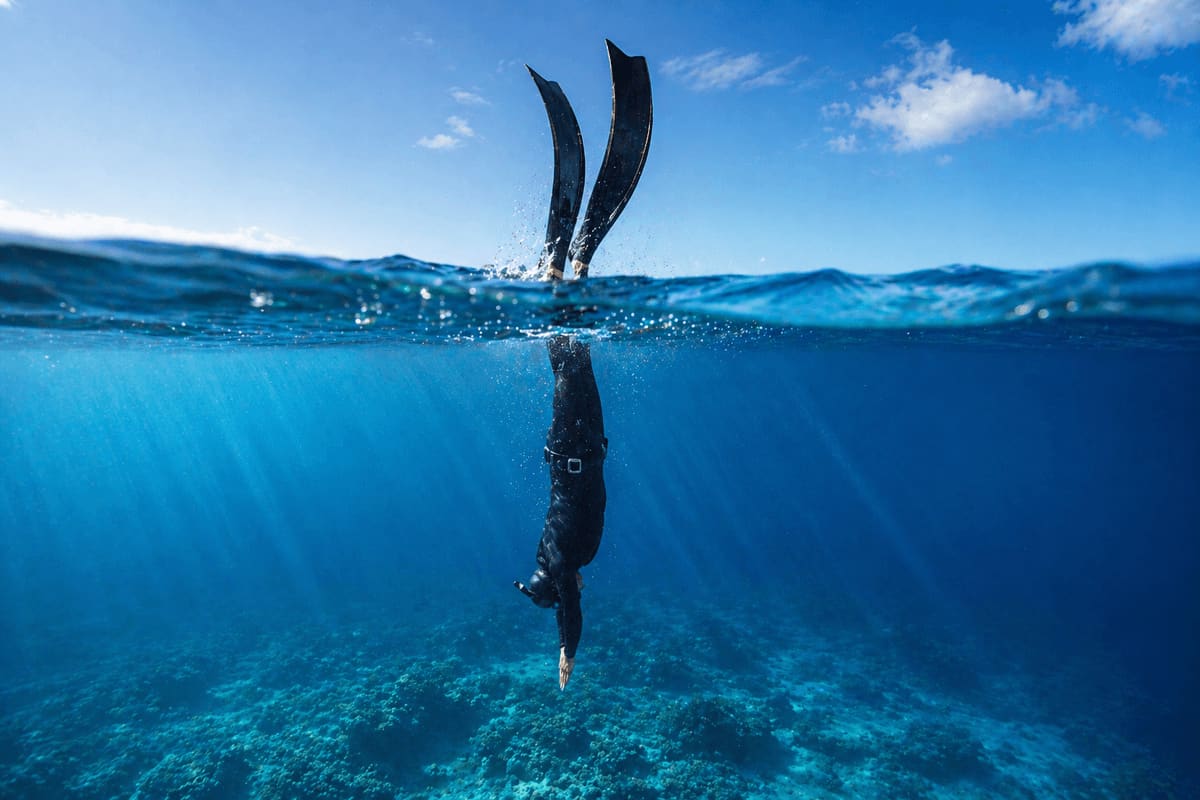

Safety First
Never freedive alone. Dive with a trained buddy who watches every dive from the surface, use a buoy with a dive flag, and book courses only with certified instructors. In Greece, dial 112 for any emergency.
Why Crete works for freediving
Crete is the largest Greek island and sits at the southern edge of the Aegean, between the Sea of Crete and the Libyan Sea. It stretches 260km (160mi) from east to west but is only 60km (37mi) across at its widest, which means no part of the island is far from the sea and both coastlines are within reach of a single base. That shape is the reason freediving on Crete is so flexible: when one coast is blown out, the other is often calm.
The broader guide to freediving in Greece gives Crete a single section alongside Amorgos and Lefkada. This page goes further: which coast suits which month, where the known freediving spots are in each region, what the water temperature does through the year, and how to plan a course or training week around the wind.
Three things make the island stand out. Deep water is close to shore on the south coast, so line training does not always need a boat. Warm water runs from June into October. And every major agency is represented, from a dedicated freediving school in the south to north coast scuba centers running PADI Freediver courses.
Two seas, two coasts: the Sea of Crete and the Libyan Sea
The north coast faces the Sea of Crete. Chania, Rethymno, Heraklion and Agios Nikolaos all sit on this shore, joined by the main highway, and both main airports are here. The downside for freedivers is exposure to the summer meltemi, which blows from the north and northwest straight onto this coast.
The south coast faces the Libyan Sea, which has an average depth of around 1,500m and drops off steeply in places near the Cretan shore. Villages here are smaller, reached by winding mountain roads, and those same mountains shelter the south from the meltemi. The trade is depth close to the beach and quieter water for more driving and fewer services.
- North coast (Sea of Crete)
- Cities, airports and sheltered bays such as Elounda and Agia Pelagia. Exposed to the meltemi in July and August. Easier logistics, busier water, more boat traffic near towns.
- South coast (Libyan Sea)
- Deep water near shore, the island's dedicated freediving school at Plakias, and remote villages in the southwest. Sheltered from the meltemi, but prone to strong downslope gusts on summer afternoons.
Crete freediving regions compared
Crete is divided into four regional units, from west to east: Chania, Rethymno, Heraklion and Lasithi. Each has a north coast and a south coast, and the freediving character of each is different. The table below summarizes the spots that local sources name for freediving, and what each suits.
The split matters more than it looks on a map. Chania town and Elounda are at opposite ends of a 260km island. A base in Plakias gives you the south coast every morning, with the north coast reachable on a windy day. For a first trip, pick one base and one school rather than trying to cover the whole island.
The south coast: Plakias, Schinaria and the Libyan Sea villages
Plakias is a village in the Rethymno regional unit, about 21km south of Rethymno town, with mountains behind it and the Libyan Sea in front. Its main beach is long and sandy and shelves gradually into the bay. It is also home to Freedive Crete, the island's dedicated freediving school, which makes it the natural base for anyone who wants Libyan Sea freediving with instruction.
Schinaria
Schinaria is the main training site used by the Plakias school, which describes it as a beach site that reaches 30m of depth. It sits a short drive east of the village, and because the depth is reachable from the beach, a typical session uses a buoy and line rather than a boat, which keeps days simple and cheaper.
Agios Pavlos and the Chania south coast
Further east along the Rethymno coast, Agios Pavlos is another spot named by local guides for freediving at varying levels. West of Plakias, the Chania south coast villages of Sfakia, Sougia and Paleochora are wild, beautiful and much more remote. Local guidance describes them as sites that call for an advanced freediver or someone with one along. Treat them as places to explore with an experienced buddy after a course, not as places to learn.
Heraklion and Lasithi: Agia Pelagia, Dia and Elounda
The north coast east of Rethymno has fewer dedicated freediving options but some useful sheltered water. Agia Pelagia, west of Heraklion, is described by local guides as well protected from the summer winds, suitable for both beginners and advanced freedivers, with large amberjack and dentex seen there. That shelter is unusual on a coast that otherwise takes the meltemi head on, which makes it a good backup on windy days. The Eurodiving center on Lygaria beach in Agia Pelagia sells a short freediving introduction for newcomers.
Dia is a small uninhabited island north of Heraklion, about 7 nautical miles offshore. It is reachable only by boat, and local sources list it for experienced freedivers, so go with a skipper who understands freediving and a calm forecast.
Elounda and Agios Nikolaos
In Lasithi, Elounda sits about 12km from Agios Nikolaos on the edge of Mirabello Bay. The water between Elounda and the Spinalonga peninsula is enclosed, which gives it a naturally protected harbor. Local guides list Elounda for freediving at varying depths for all levels. Scuba centers operate in both Elounda and Agios Nikolaos; ask any of them directly whether they have a freediving instructor on staff before booking, because scuba certification is not the same thing.
Kali Limenes
On the south coast of the Heraklion regional unit, Kali Limenes is another spot local guides name for freediving. It is also a major bunkering port where ships stop to refuel, so large vessels and service boats are part of the scenery. Dive there only with a clearly visible buoy and flag, and stay well away from the anchorage.
Water temperature by month and what wetsuit to wear
Sea temperature data for Chania and Heraklion shows a long warm season with a steep climb in late spring. Water sits around 16-17°C (61-63°F) from January to April, reaches 19°C (66°F) in May, jumps to about 23°C (73°F) in June and peaks at about 26°C (79°F) in August. It stays warm through September and cools gradually from October. The two north coast cities track each other within a few tenths of a degree all year.
These are average surface temperatures; it feels colder at depth and during long, still surface intervals. The site's wetsuit thickness guide explains how to match suit to temperature and how the extra buoyancy changes your weighting.
Wind, sea state and visibility
Wind decides most freediving days on Crete. The meltemi is a dry wind from the north and northwest that dominates the Aegean in summer, strongest in July and August, often in spells lasting several days. On the north coast it can produce rough, confused seas, which make surface intervals uncomfortable, push buoys off position and stir up the water. The sheltered exceptions are bays facing away from the wind, such as Elounda and Agia Pelagia.
The south coast does not get the meltemi directly, but it gets something harder to predict. Air pouring over the mountains drops onto the Libyan Sea as katabatic gusts, most active from late morning to evening between July and September. When the meltemi and these gusts combine, local guidance for sea kayakers describes the sea state on the south coast as chaotic and often dangerous for the inexperienced. The practical answer is an early start. A session from about 8am to 11am avoids most of the afternoon wind.
- Check a marine wind forecast every evening, and note direction as well as speed: a north wind that roughs up Heraklion may leave Plakias calm.
- Keep one backup site on the opposite coast and budget the drive time to reach it.
- On days with gusts forecast, finish in the morning.
Visibility follows the wind. On calm summer days both coasts can be very clear, and south coast operators advertise visibility above 20m in the Libyan Sea. After a windy spell, the exposed coast clouds up for a day or two while the sheltered one stays clean. No single number describes Crete, so treat any quoted visibility as a good-day figure and plan around the forecast.
Crete freediving courses: agencies, structure and prices
Courses on Crete follow the same agency standards as anywhere else. Freedive Crete in Plakias runs Molchanovs (Wave 1 to 3), AIDA (2 to 4) and SSI (Level 1 and 2, with Level 3 announced but not yet running) programs, with no more than four students per instructor. On the north coast, Omega Divers, with its main center in Almyrida and a shop in Chania town, runs the PADI Freediver course. If you are unsure which card to aim for, the comparison of the best freediving certification covers how the agencies line up.
Private versions of the same courses cost more, roughly €490-750 depending on level. These Crete prices sit above the Greece-wide beginner range quoted elsewhere on this site, which fits the pattern of popular islands charging more. The introductory option on the north coast is shorter and cheaper: the Agia Pelagia session starts from €70 and runs under two hours, including theory. For how course fees fit into the full budget of the sport, see the breakdown of what freediving costs.
What a beginner course looks like
- 01 —Theory: how breath-hold works, equalization, the mammalian dive reflex, blackout risk and buddy procedures.
- 02 —Breathing and relaxation on land before the first water session.
- 03 —Static and dynamic work in shallow, calm water to build comfort with the breath-hold.
- 04 —Line dives from a buoy, adding depth gradually while learning the duck dive, free immersion and equalization.
- 05 —Rescue drills: recovering a blacked-out buddy from depth and bringing them back at the surface.
- 06 —Final depth and breath-hold requirements for certification, then a written test.
Getting there and getting around
- Chania International Airport (CHQ)
- Officially named Daskalogiannis, it sits on the Akrotiri peninsula about 14km from Chania town and is a joint civil and military airfield. It is the gateway for western Crete and a sensible choice for a south coast trip to Plakias or the Chania villages.
- Heraklion International Airport (HER)
- Named Nikos Kazantzakis, it is the busiest airport on the island and the second busiest in Greece after Athens. Use it for Agia Pelagia, Heraklion, Elounda and Agios Nikolaos. A new airport at Kastelli is under construction to replace it, so check which airport your ticket names if you travel once it opens.
- From the US
- Plan on at least one connection, usually through Athens or a major European hub. Domestic flights from Athens to Chania and Heraklion are short and frequent in summer.
A rental car is close to essential. The main highway runs along the north coast, linking Chania, Rethymno, Heraklion and Agios Nikolaos. Reaching the south coast means crossing the mountains on slower, winding roads. For Plakias, drive to Rethymno on the highway and then head about 21km south. Carrying a buoy, a line, weights and long fins on a bus is impractical, and several of the south coast sites have no useful public transport at all.
A sample freediving week on Crete
This plan assumes a beginner certification based in Plakias, a September trip and a rental car from Chania or Heraklion. It keeps dive sessions in the morning, leaves room for a wind day, and ends with a rest day before the flight.
- 01 —Day 1: Land at Chania or Heraklion, pick up the car, drive to Plakias. Easy swim and snorkel to check your mask and suit.
- 02 —Day 2: Course day one. Theory, breathing work and the first shallow line dives at Schinaria in the morning.
- 03 —Day 3: Course day two. Deeper line dives, equalization practice and rescue drills. Afternoon off the water.
- 04 —Day 4: Course day three. Final depth requirements and the written test. Certification complete.
- 05 —Day 5: Buffer day for wind. If the south is blown out, drive north to a sheltered bay; if calm, book a supervised training session.
- 06 —Day 6: Fun dives with your course buddy on a buoy and line, or a guided session with the school. Rest in the afternoon.
- 07 —Day 7: No diving. Drive back to the airport and fly home the next day.
Experienced freedivers can swap the course for an intermediate program or supervised training sessions, keeping the same rhythm: dive early, rest in the afternoon. The overview of the best places to freedive is useful if you want to compare Crete with other warm-water destinations before committing.
Safety on Crete
Freediving safety on Crete comes down to the same rule as everywhere: never dive alone. Every dive needs a trained buddy at the surface, watching you from the start of the descent until you have recovered after surfacing. The freediving buddy system explains the one-up, one-down routine and the surface watch in detail. Many of Crete's quieter south coast spots have no lifeguard and no one else nearby, so your buddy is the only rescue there is.
"Always dive with a buddy. Never dive alone."
Buoys, flags and boat traffic
Crete's bays carry swimmers, pedal boats, fishing boats, day-trip boats and, near towns, jet skis. A skipper cannot see a freediver below the surface, so the only protection is a visible surface marker. Greek rules for underwater fishing require a buoy with a dive flag and say the diver must stay within 50m of it, and freedivers who are not fishing should follow the same practice. A good freediving buoy also gives you a line to dive on and something to rest on between dives.
- Dive from a flagged buoy and surface next to it.
- Avoid harbor mouths, ferry routes and anchorages.
- Check the current before descending by watching which way the buoy drifts.
- Book courses only with certified instructors, and ask what rescue and oxygen equipment they carry.
Blackout, not decompression sickness, is the main risk in freediving, and it is survivable only if a trained buddy is there to act. Where the water is warm and the depth is close to shore, the temptation is to push. Stay well within your limits on unfamiliar sites and rest fully between dives.