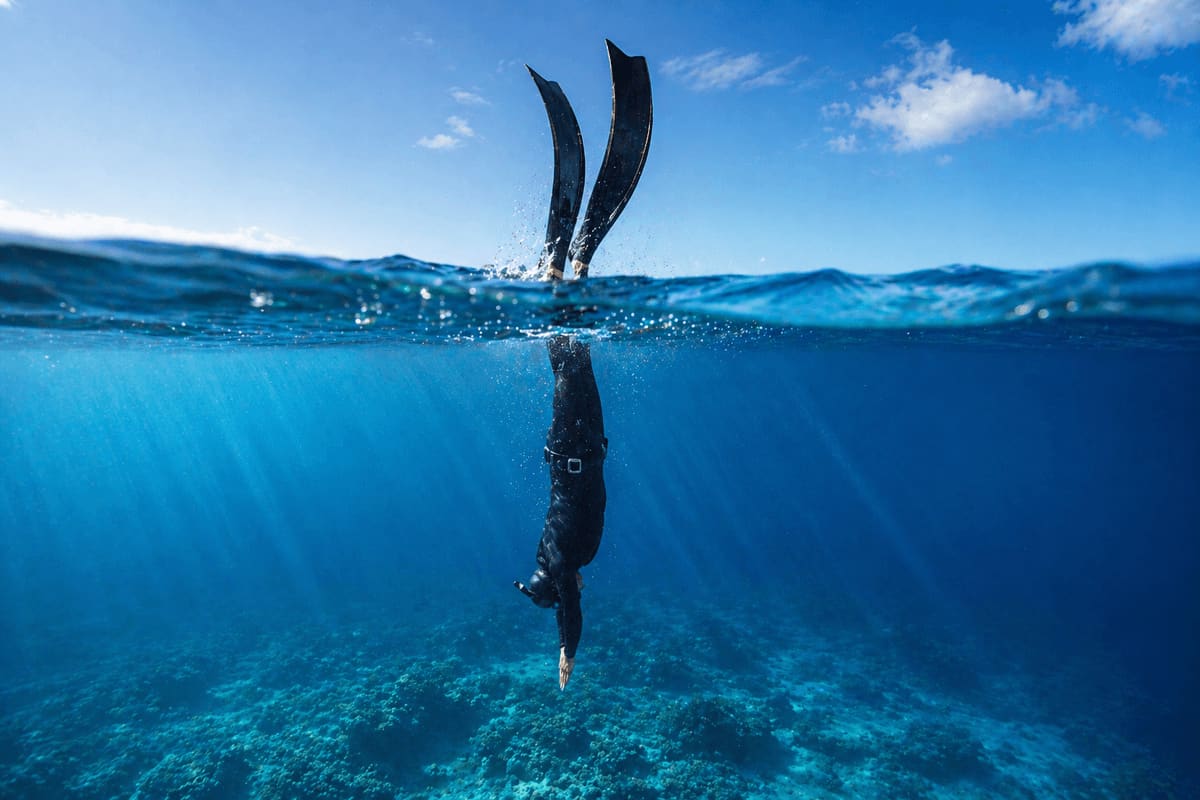

Why Greece belongs on every freediver's shortlist
Greece has over 6,000 islands and islets, nearly 14,000km of coastline, and water that competes with Egypt and the Caribbean for clarity. The combination of the Aegean's limited tidal exchange, minimal industrial runoff at island sites, and consistently clear summer conditions produces visibility values (typically 20-30m at good sites, 30-40m at the best) that most European divers have to travel to Egypt to find. The difference is you can fly into Athens in 3-4 hours from most of Western Europe and reach a quality island in another 1-2 hours.
Greece also carries a cultural significance in the sport that no other country matches. Amorgos is where Luc Besson filmed The Big Blue (1988), the film that turned freediving from a niche professional pursuit into a global recreational movement. The island still draws freedivers from across the world who come specifically because of the film. The competition site near Agia Anna, where the depth reaches 150m, is one of the most storied spots in the sport's modern history.
Amorgos: the pilgrimage island of freediving
Amorgos is the easternmost of the Cyclades, a long narrow island of dramatic cliffs and transparent water. It is not a mass-market tourist island: there are no package-holiday hotels and the ferry connections are longer than the Santorini circuit. Divers who make the journey find one of the cleanest marine environments in the Greek islands, a dive center with direct pool and open-water access, and dive sites that carry genuine historical weight in the sport.
The Big Blue Wall
The Big Blue Wall runs along the western face of Amorgos, dropping from the cliff base to open ocean. The wall itself features shoals of barracuda, grouper, large amberjack, and the chance to encounter dolphins and turtles on deeper passes. Visibility in September, which the Authentic Big Blue competition uses as a benchmark, runs 30-40m. The site requires boat access from Katapola or Aegiali, the two main ports.
Nikouria and the underwater cave
Just outside the beach of Agios Pavlos sits Nikouria, an uninhabited islet with an underwater cave filled with colorful sponges and reef fish. The cave is accessible to confident freedivers without technical equipment and represents an excellent intermediate dive. The protected water between Nikouria and the main island is used by Amorgos Diving Center for confined water training.
- Agia Anna competition site
- The site of the Authentic Big Blue competition, approximately half a mile offshore from the beach where key scenes of the 1988 film were shot. The seafloor drops to 150m. Advanced freedivers can train depth here with appropriate supervision. The beach itself is a pebble cove only accessible by foot path or sea. It is one of the most photographed locations on the island.
- Katapola harbor sites
- The main port has several accessible reef dives directly from the harbor edge, suitable for warm-up dives and beginner sessions. Depths range from 5m to 20m. Easy entry, no boat required.
- Levrossos
- A small island south of Amorgos accessible by day-charter, known for particularly clear water and walls to 30m+ with strong fish presence. One of the best day-trip options for serious freedivers based on Amorgos.
Crete and the Libyan Sea: southern Greece's best visibility
Crete is the largest Greek island and sits at the southernmost edge of Europe, facing the Libyan Sea to the south. The Libyan Sea's depth and position, far from mainland river runoff and industrial traffic, gives it exceptional clarity. Year-round visibility at south Crete sites regularly exceeds 20m and can hit 30m+ in the summer months. The island's north coast (facing the Sea of Crete) has slightly lower visibility but more developed infrastructure and easier access from Heraklion airport. Our separate guide to freediving in Crete covers the island region by region, with water temperatures by month and course prices.
Plakias and the south coast
Plakias is a small south-coast village about 2 hours by road from Heraklion. Freedive Crete operates from here with Molchanovs and SSI certification courses. The site conditions are excellent: calm water through most of the summer, consistent visibility, and shore-accessible reef and wall dives at 10-30m. Beginner freedivers typically reach 10-15m within a 2-3 day Wave 1 or SSI Level 1 course.
Other Crete sites
Elounda Bay on the northeast coast is known for calm, protected water with reef at 15-25m, a good option for beginners and casual freediving outside a formal course. The island of Dia, 7 nautical miles north of Heraklion, is a protected marine reserve with some of the cleanest water near the island's north coast. Agia Pelagia on the northwest coast has a maximum depth of approximately 60m (rare for near-shore Aegean sites) and is accessible by local boat. The Rethimnon area sites (Agios Pavlos, Schinaria) offer shore access to reef at 10-20m.
Lefkada and the Ionian Sea: calm water, AIDA courses
Lefkada is an Ionian island on Greece's west coast, connected to the mainland by a causeway. The Ionian Sea runs slightly warmer and calmer than the Aegean, making it a strong option for learning. Water temperatures range from 21°C in spring to 28°C at the August peak. Freedive Lefkada, a dedicated AIDA-certified center based in the island's south, offers AIDA 1-3 courses with both pool access and open-water training in protected bays.
- Water conditions
- The Ionian is calmer than the Aegean in most wind conditions. Lefkada's sheltered east coast bays offer flat-water training conditions even when the open Ionian is choppy. Visibility is typically 15-25m in summer, lower than Amorgos but consistent and adequate for all course levels.
- Dive sites
- The south of the island offers shore-accessible reef at 10-20m and several wall sections descending to 30m+. Local operators run boat trips to more exposed sites on the west coast with stronger marine presence. Porto Katsiki, Lefkada's famous cliff beach, has accessible snorkeling and shallow freediving in 5-15m of clear water.
- AIDA courses
- Freedive Lefkada is one of a handful of dedicated freediving schools in Greece. AIDA 1 (pool only), AIDA 2 (beginner open-water certification), and AIDA 3 (intermediate) are all available. The center has a pool on site and open-water access from their base. This is one of the most complete AIDA training setups in Greece outside Athens.
- Getting there
- Lefkada Airport does not exist. The nearest airports are Preveza/Aktion (10 minutes from the causeway) and Kefalonia (ferry connection). Preveza has direct summer flights from several European cities. From Athens, it is a 5-6 hour drive or a short domestic flight to Preveza.
Freediving courses and centers in Greece
Greece has AIDA, SSI, Molchanovs, and PADI-certified freediving instruction at a growing number of islands. The main dedicated freediving schools (as distinct from scuba dive centers that add freediving as a secondary offering) are Amorgos Diving Center, Freedive Lefkada, Freedive Crete, Blue Island Divers (Antiparos), and Freediving Club Greece (Athens). Athens is the most accessible starting point for a beginner certification before island travel.
When to go: seasons and site conditions
September is the strongest single month for Greek island freediving. The Meltemi wind, which generates choppy conditions at exposed Cyclades sites in July-August, drops significantly after mid-August. Water temperature is still 24-25°C. Tourist volume on the islands falls 20-30% from August. The Authentic Big Blue competition at Amorgos is typically held in late September, which gives the water conditions a stamp of approval from competitive freedivers.
Getting there and practical logistics
- Flights
- Athens International Airport (ATH) is the main hub with direct flights from most European cities and one-stop connections from the US (typically via Frankfurt, London, Amsterdam, or Paris). Direct US-Athens flights exist on Olympic Air and some charter routes in summer. Heraklion (Crete) has direct summer flights from Northern Europe. Preveza (for Lefkada) has limited direct summer flights from select European cities. Domestic flights from Athens to Heraklion, Rhodes, Santorini, and other islands take 45-75 minutes.
- Island ferries
- Blue Star Ferries and Hellenic Seaways operate the Cyclades and Dodecanese routes. Athens (Piraeus) to Amorgos: 5-9 hours depending on the vessel and route. Athens to Santorini: 5 hours by high-speed, 8-9 hours by regular ferry. Crete (Heraklion) to Santorini: 2 hours by high-speed. Inter-island connections within the Cyclades are extensive in summer and very limited October-April. Check ferryscanner.com for current routes and times.
- Accommodation
- Greece has a full range: studios and apartments (similar to Croatia's apartmani model), family-run guesthouses, boutique hotels, and international chains. Amorgos is affordable by Greek standards: a good studio runs $70-120/night in summer. Santorini and Mykonos are the most expensive islands ($150-400+/night is typical). Crete has options across all price ranges. Book July-August accommodation 2-3 months ahead on popular islands.
- Equipment
- Freediving-specific gear rental (open-cell wetsuits, long-blade fins, low-volume masks) is available at dedicated freediving centers. Scuba dive shops on the main tourist islands typically stock recreational snorkeling equipment, not freediving-specific gear. Bring your own low-volume mask if you have one. Long-blade carbon fins as airline checked sports baggage is standard practice. Most airlines allow this.
- Currency
- Greece uses the Euro (EUR). ATMs are widespread on all but the smallest islands. Carry some cash for smaller tavernas and remote sites that do not take cards. Budget roughly $30-70/day for food depending on your accommodation choice. Eating at local tavernas is significantly cheaper than tourist-facing restaurants.
- Language and visas
- Greek is the official language but English is widely spoken in tourist and diving contexts. EU/EEA citizens do not need a visa. US, UK, Australian, and Canadian citizens can stay up to 90 days without a visa under Schengen rules. Check current entry requirements if traveling from outside these regions.