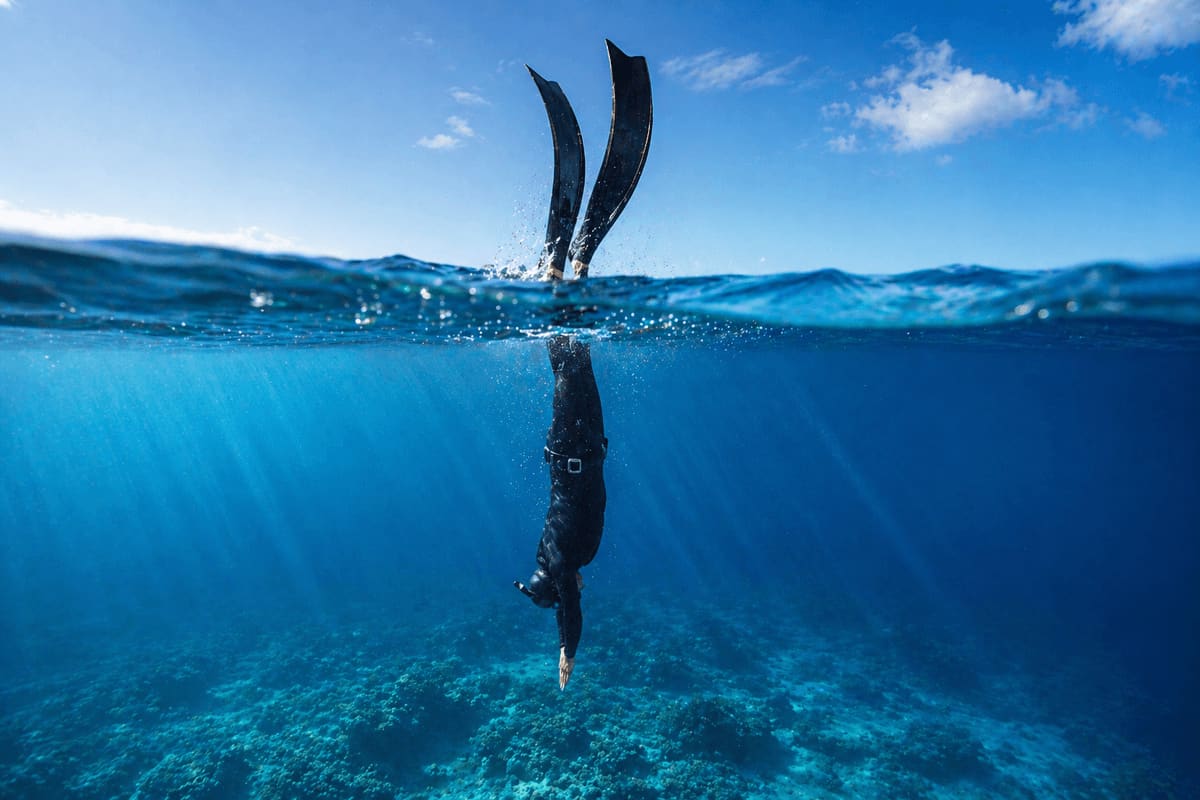

No Limits: The Absolute Deepest
The deepest freedive ever recorded belongs to Austrian athlete Herbert Nitsch, who reached 214m in the No Limits discipline in 2007. No Limits allows a weighted sled for the descent and a lift bag or balloon for the ascent, so the diver does not swim under their own power. That removes the effort of finning but does nothing to protect the body from pressure. For a full ledger of every discipline record, see our freediving world records table, which tracks each mark separately.
In 2012 Nitsch attempted a 244m No Limits dive and suffered a severe decompression accident on the way up, losing consciousness and later dealing with a stroke and a long recovery. That single event reshaped the sport. No Limits is now essentially retired as a competitive category. No major sanctioning body actively promotes new attempts, and most athletes consider Nitsch's 214m a record that will simply stand rather than a target to beat.
The Deepest Dives by Discipline
Depth is not one record, it is several, because the rules of each discipline change what the body has to do. Assisted disciplines like No Limits and Variable Weight reach the deepest numbers, while the self-powered disciplines sit lower because the diver has to physically move through the water. If you want the mechanics of each category, our guide to freediving disciplines breaks down the rules one by one.
Numbers in this sport move, so treat the ranges as the ballpark rather than a frozen figure. Alexey Molchanov has repeatedly pushed the Constant Weight mark past 130m, and Variable Weight numbers from athletes like Walid Boudhiaf and Nanja van den Broek sit in the 130m to 150m range depending on the year and the ratification. What does not change is the ordering: the more the diver has to do under their own power, the shallower the ceiling.
Constant Weight and No Fins
Constant Weight with fins is the flagship competition discipline, the one you see on the deep lines at world championships. The diver takes a fixed amount of weight down and must bring it all back, swimming the entire way with a monofin or bifins and no pulling on the rope. Alexey Molchanov has owned the top of this category, taking it past 130m, a depth that requires an advanced equalization method most divers reach through the mouthfill technique to keep pushing air into the ears once the lungs are too compressed to help.
The purest record: no fins at all
Constant Weight No Fins strips everything away. No fins, no line to pull, no sled. The diver breaststrokes down into darkness and swims back up using only arms and legs, working against a body that is trying to sink at depth and float near the surface. William Trubridge defined this discipline, taking it to around 102m off the Bahamas. Many coaches consider it the truest measure of human depth because nothing mechanical helps the athlete move.
- Constant Weight (CWT)
- Swim down and up with fins, carry all weight both ways. Molchanov 130m+.
- Free Immersion (FIM)
- No fins, pull down and up on the line hand over hand. Reaches the 120m+ range.
- Constant Weight No Fins (CNF)
- No fins, no pulling, no assist. Trubridge around 102m, the hardest number to earn.
Why Extreme Depth Is So Dangerous
Depth is dangerous because several separate threats stack on top of each other and peak at different points of the dive. None of them are exotic, they are the same forces recreational divers manage in smaller doses, only multiplied. Our overview of whether freediving is dangerous covers the everyday version, but at record depth the margins shrink to almost nothing.
The four main threats at extreme depth
- Nitrogen narcosis: under high pressure, nitrogen behaves like an anesthetic, clouding judgment and coordination past roughly 30m and worsening the deeper you go, so decision making fails when it matters most.
- Lung squeeze: as pressure compresses the chest, the lungs shrink toward a fraction of their surface volume, and if tissue cannot flex enough, capillaries tear and fill the airways with blood, a barotrauma explained in our <a href='/freediving-safety/lung-squeeze/'>lung squeeze guide</a>.
- Blood shift: the body pulls plasma into the chest to keep the compressed lungs from collapsing, a protective reflex that also strains the heart and vessels at extreme depth.
- Blackout on ascent: oxygen falls fastest in the final meters as pressure drops, so many divers stay conscious at depth and then black out near the surface, which is why safety divers meet record attempts in the last stretch.
The Gap From Recreational Depth
To feel how extreme these records are, compare them to where normal humans dive. A trained recreational freediver typically works between 20m and 40m, and reaching 40m already takes structured practice and good equalization. A 100m dive is more than double that, and a 200m dive is another world entirely. Our guide to how deep you can freedive walks through what is realistic at each stage of training.
The point of the comparison is not to discourage anyone. It is to show that the deepest dive without oxygen tanks in history sits roughly five to ten times deeper than where most enthusiasts safely spend their time. The athletes who set these marks did not skip the middle, they spent a decade in it, and the records are the visible tip of a very long and careful process.
What the Records Actually Mean
The deepest freedive ever is a story about a few extraordinary people and the exact physical limits of a body on one breath. Herbert Nitsch's 214m stands as the absolute mark, William Trubridge's roughly 102m shows what is possible with nothing but arms and legs, and Alexey Molchanov keeps proving the finned disciplines still have room to grow. Each number is a snapshot of training, physiology, and acceptable risk meeting in one dive.
If you want to keep going, start with the full freediving world records table to see how every discipline stacks up, then read how the disciplines differ so the depth numbers make sense in context. The records are impressive precisely because so much has to go right, and so little is allowed to go wrong.